.png&w=1920&q=75)
Posted on 06/18/2026
What Are the Key Specifications to Consider for an Outdoor LED Video Wall?
You have probably seen them at trade shows, concert stages, luxury hotel lobbies, sports arenas, and outdoor plazas — massive, vivid displays that seem to breathe with light and color. LED video walls have become the defining visual statement for any space that wants to make an impression. But here is where most buyers hit a wall — pun intended: what does it actually take to pick the right one?
Whether you are an event producer, an AV integrator, a venue manager, or a brand looking to upgrade its retail experience, choosing an LED video wall is one of those decisions that feels simple on the surface and bewilderingly technical underneath. Pixel pitch, refresh rate, IP ratings, power draw, brightness in nits — the specifications list alone can feel like a foreign language.
This guide breaks it all down in plain language. We will walk through every key specification you need to understand before buying or specifying an outdoor LED video wall (and indoor ones too), answer the questions buyers most commonly ask, and show you exactly how the three LED display products from Rasha — Professional Stage Lighting and Video Wall Manufacturer — map to real-world use cases.
Quick Note: Not every LED video wall is designed for outdoor use. Some are built exclusively for indoor environments with controlled lighting and no exposure to weather. This guide covers specifications relevant to both, with clear callouts for where outdoor requirements differ significantly.
What Is Pixel Pitch and Why Does It Matter More Than Screen Size?
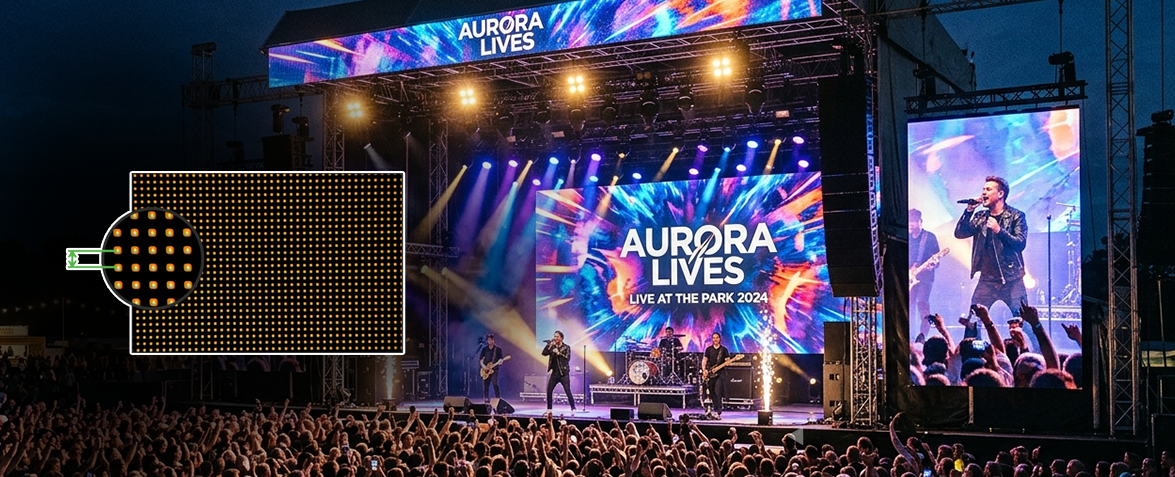
This is the first question almost every first-time buyer asks — and the answer changes how you think about every other specification on the list.
Pixel pitch is the distance (measured in millimeters) between the center of one LED cluster and the center of the next. A 1.86mm pixel pitch means each pixel is spaced 1.86 millimeters apart. A 10mm pitch means 10 millimeters apart. The smaller the number, the tighter the pixel density, and the sharper the image looks at close viewing distances.
Here is the key insight: pixel pitch defines your minimum comfortable viewing distance. If viewers stand closer than that minimum, they will see individual pixels — the image becomes grainy and the colors look washed. Stand at or beyond that distance, and the image looks seamless and razor-sharp.
A general rule of thumb used in the industry is that the minimum viewing distance in meters roughly equals the pixel pitch in millimeters. So a 2.5mm pixel pitch is comfortable from about 2.5 meters (roughly 8 feet) away. This is why fine-pitch panels in the 1.86mm to 2.5mm range are preferred for indoor environments like lobbies, bars, and event stages where audiences are close to the screen — and why larger pitches are perfectly appropriate for outdoor billboards and stadium scoreboards where viewers are far away.
Pixel Pitch vs. Minimum Viewing Distance
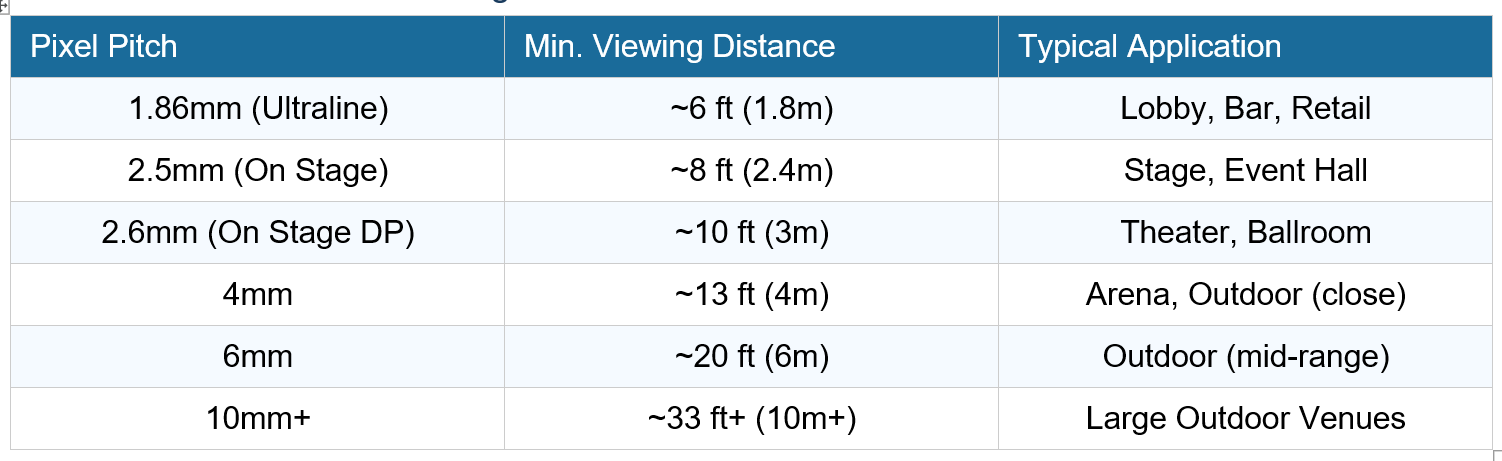
Source: Industry standard viewing distance formula (pixel pitch mm ≈ min. viewing distance in meters)
For outdoor LED video walls specifically, the viewing distance is typically larger — audiences are further away. This means you can often use a larger pixel pitch (which costs less per panel) without sacrificing perceived image quality. However, if your outdoor installation is in a venue where people walk up close — a retail storefront, a hotel entrance canopy, or an outdoor bar — you need a finer pitch, and weather protection becomes a separate critical requirement.
Rasha's On Stage P2.6 is rated IP31 standard and IP65 on specific panels, making it one of the few rental-grade panels that transitions from indoor stage setups to outdoor event environments without requiring a separate product SKU.
What Is Brightness (Nits) and How Bright Does an Outdoor LED Video Wall Need to Be?
-and-How-Bright-Does-an-Outdoor-LED-Video-Wall-Need-to-Be.png)
Brightness is measured in nits — one nit equals one candela per square meter (cd/m²). It tells you how much light the panel emits, which directly determines whether your content stays visible in different lighting conditions.
For indoor environments with controlled ambient light, 800 to 1,200 nits is typically sufficient. Corporate lobbies, conference rooms, indoor stages, and retail interiors usually sit in this range. For semi-outdoor or covered outdoor environments — think hotel porte-cocheres, rooftop terraces, covered outdoor stages — you generally want 2,000 to 3,500 nits.
For fully exposed outdoor installations — digital billboards, outdoor amphitheaters, sports venue perimeter boards — you are looking at 4,000 to 7,000 nits and sometimes higher. In direct sunlight, ambient light competes aggressively with the display, and a screen that looks stunning indoors can look washed-out and dim when the sun is overhead.
Recommended Brightness by Environment
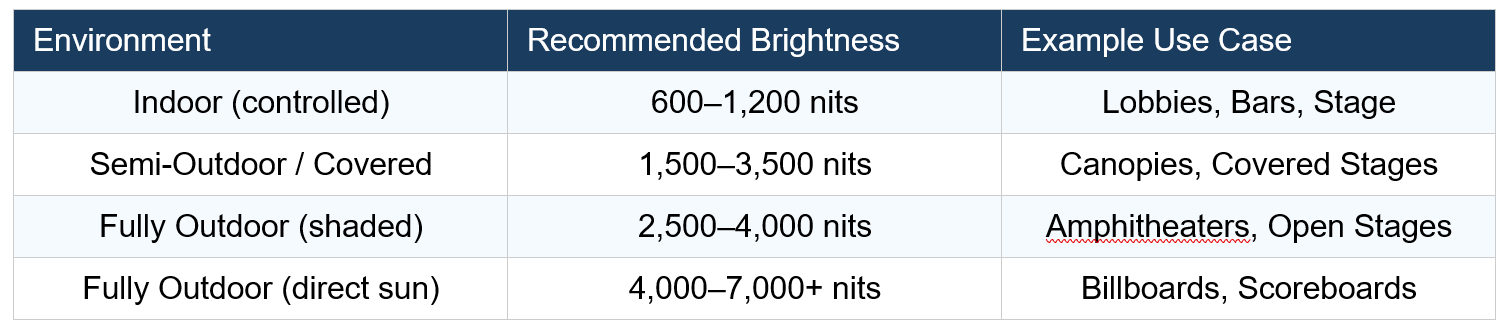
Source: Daktronics and LED display industry brightness guidelines
Rasha's indoor panels — the Ultraline 1.86 and On Stage series — are rated at 800 to 1,000 nits, which is appropriate for their intended environments. For fully exposed outdoor permanent installs, the On Stage P2.6's adjustable brightness feature (0 to 100% dimming) gives operators flexibility to dial in exactly what the environment demands.
What Does IP Rating Mean and Which One Do You Need for Outdoor Use?
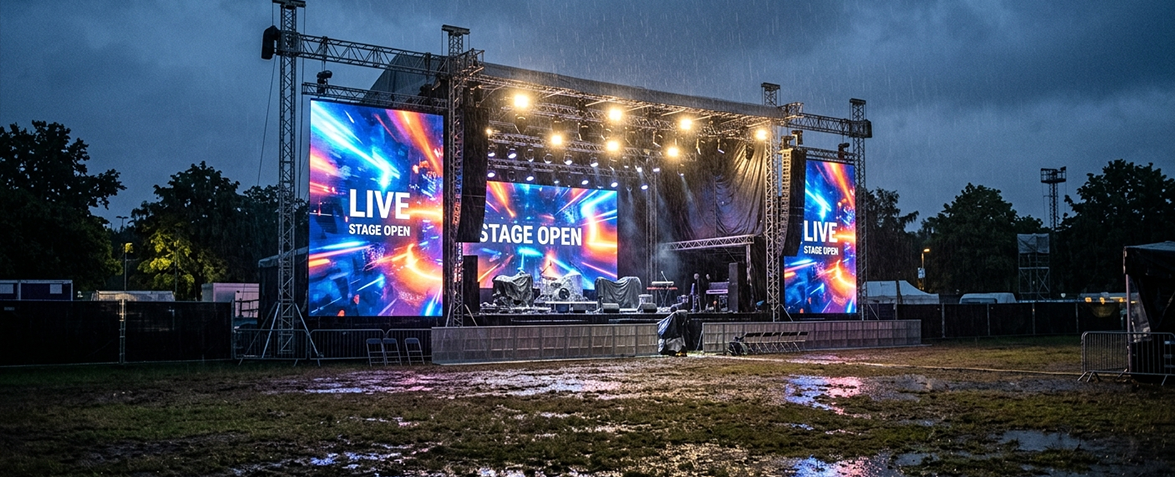
IP stands for Ingress Protection — it is a standardized rating defined by IEC standard 60529 that tells you how well a device is sealed against solid particles (like dust) and liquids (like rain). The rating is expressed as two digits: the first covers solids, the second covers liquids.
For outdoor LED video walls, the IP rating is not optional — it is one of the most important specifications you will evaluate. A panel without adequate ingress protection will fail when exposed to rain, dust, insects, and humidity. The damage is often irreversible and expensive.
Here is what the key IP ratings mean for LED panels:
IP20 — Protected against solid objects over 12mm, no water protection. For fully indoor, climate-controlled environments only.
IP31 — Protected against dust> 1 mm and dripping water. Suitable for semi-outdoor covered environments.
IP54 — Dust-tight and splash-proof from any direction. Suitable for most covered outdoor environments.
IP65 — Fully dust-tight and jet-water resistant. Suitable for direct outdoor exposure, including heavy rain.
IP67/IP68 — Submersion-rated. Required for ground-level or flood-prone installations.
The On Stage DP from Rasha carries a dual IP rating of IP30 and IP65 depending on the panel orientation and module configuration — meaning it can be configured for both indoor and protected outdoor environments. This dual-rating flexibility is rare at this panel size and price tier.
Rule of Thumb: If your LED video wall will be outdoors in any scenario — even under a tent or partial roof — you need a minimum of IP54. For permanently exposed outdoor installations, IP65 is the industry standard.
What Refresh Rate Should an LED Video Wall Have for Live Events and Camera Coverage?
.png)
Refresh rate is the number of times per second the display redraws its image, expressed in Hz (hertz). A higher refresh rate produces a smoother, flicker-free image — which matters enormously in two scenarios: live events where cameras are present, and environments with fast-moving content.
The human eye generally cannot perceive refresh rates above 60 to 72 Hz. But cameras are different. Cameras use a shutter speed that interacts with the display's refresh cycle. If the refresh rate is too low relative to the camera's shutter speed, you get a visible horizontal banding effect — a rolling dark bar that moves across footage. This is the classic LED flicker you have seen in broadcast video.
The industry standard for broadcast-safe LED displays is 3,840 Hz. At this refresh rate, the display is completely flicker-free even when shot with cameras at shutter speeds up to 1/1,000th of a second and frame rates from 24 fps to 60 fps. This is now the baseline expectation for any professional-grade LED panel used in live events, broadcast, or any camera-visible environment.
All three Rasha LED panels — the Ultraline 1.86, On Stage P2.6, and On Stage DP — are rated at 3,840 Hz, meeting the broadcast-safe standard across the entire product lineup. The Ultraline 1.86 is explicitly rated as flicker-free at 24, 25, 30, 50, and 60 fps with shutter speeds up to 1/1,000 second.
How Do I Calculate Power Requirements for an LED Video Wall Installation?
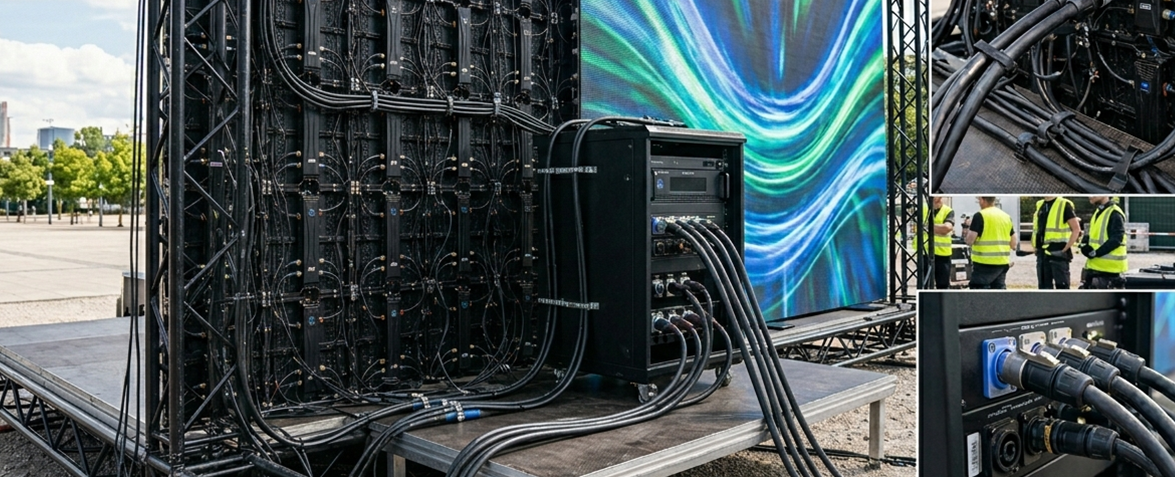
Power planning is one of the most overlooked parts of an LED video wall installation — and getting it wrong can result in tripped breakers, flickering panels, or worse, damaged equipment. Here is how to think through it.
Every panel has a maximum power consumption rating. This is the peak draw when the display is running at full brightness with full-white content — the most power-hungry scenario. In real-world operation, average power consumption is typically 40 to 60 percent of maximum, because content is rarely full-white at full brightness.
The industry-standard safety practice is to size your circuits to 80 percent of the breaker's rated capacity. So a 20-amp circuit can reliably handle 16 amps continuously. A 15-amp circuit can handle 12 amps.
Using the Ultraline 1.86 as an example, each panel draws a maximum of 128 watts (1 amp at 120V). On a 20-amp circuit, you can safely run 16 panels. On a 15-amp circuit, you can safely run 12 panels. A standard 8x6 lobby wall (48 panels) would require three 20-amp dedicated circuits.
Power Planning Reference — Rasha LED Panels

Note: Circuit calculations based on 80% continuous load rule per NEC guidelines.
Always consult a licensed electrician for power infrastructure planning. LED video wall installations should use dedicated circuits — never share with HVAC, lighting dimmers, or other high-draw equipment.
What Installation and Mounting Options Should I Consider?
How an LED video wall gets installed is just as important as the panel specifications. Installation method affects your timeline, your costs, your maintenance access, and whether the wall can be safely removed or reconfigured later.
There are generally three installation approaches for LED video walls:
1. Fixed Permanent Wall Mount
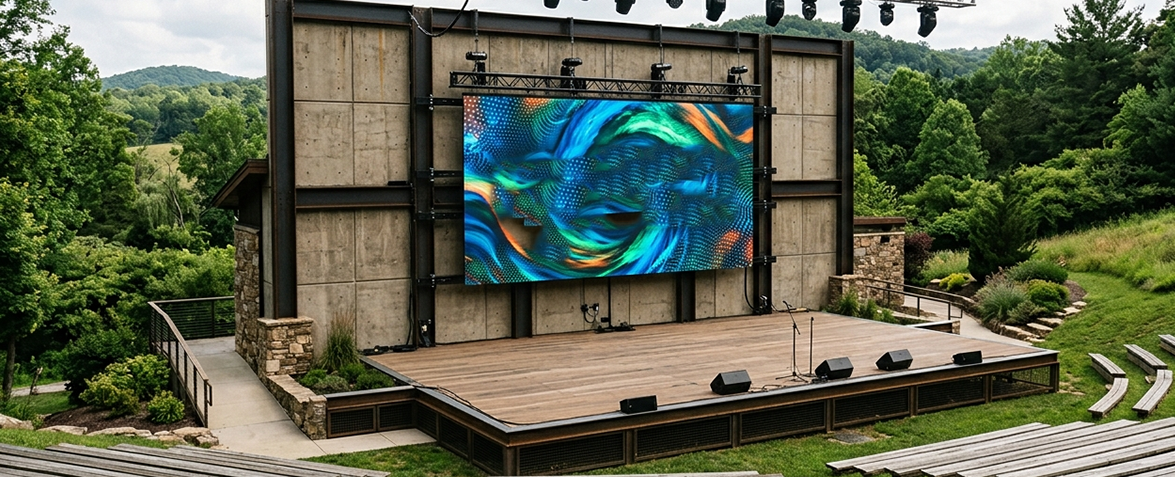
The panel is bolted to a structural backing — typically plywood over a framed wall — using threaded mounting hardware. This is the most common installation for lobbies, boardrooms, restaurants, and permanent venues. The Ultraline 1.86 is engineered specifically for this: its corner holes are 3/8-16 UNC threaded, designed to accept countersunk flush-mount screws that allow fine vertical alignment before locking in place. Importantly, it requires no rear clearance — the closed-back design lets it fit into tight architectural pockets.
2. Rigged / Flown Installation
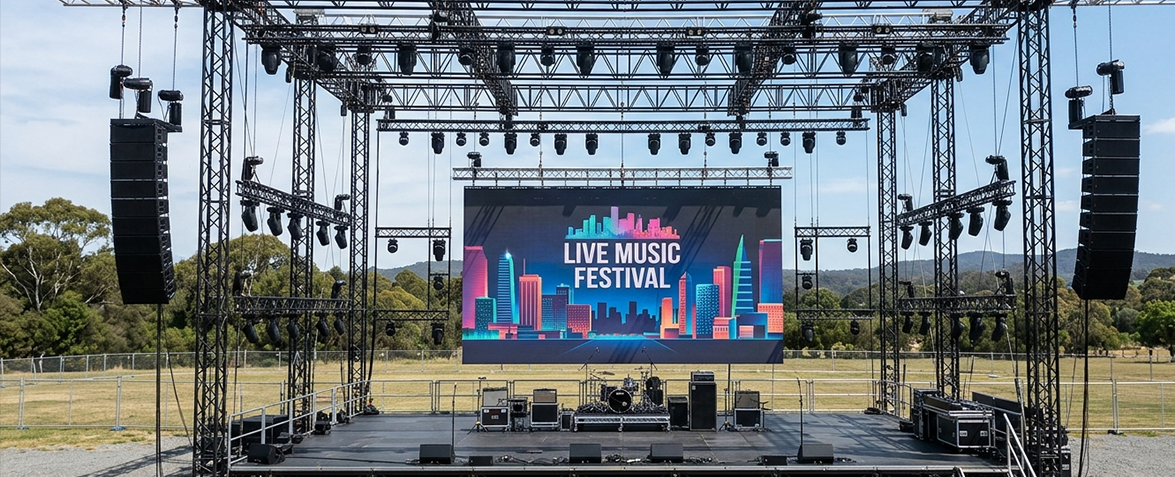
For event and rental environments, panels are hung from truss or rigging systems. The On Stage P2.6 supports this approach, offering hang, curve, or mount configurations. This is what makes it appropriate for concerts, trade show booths, and touring productions where the wall goes up and comes down repeatedly.
3. Ground Stack / Free Standing
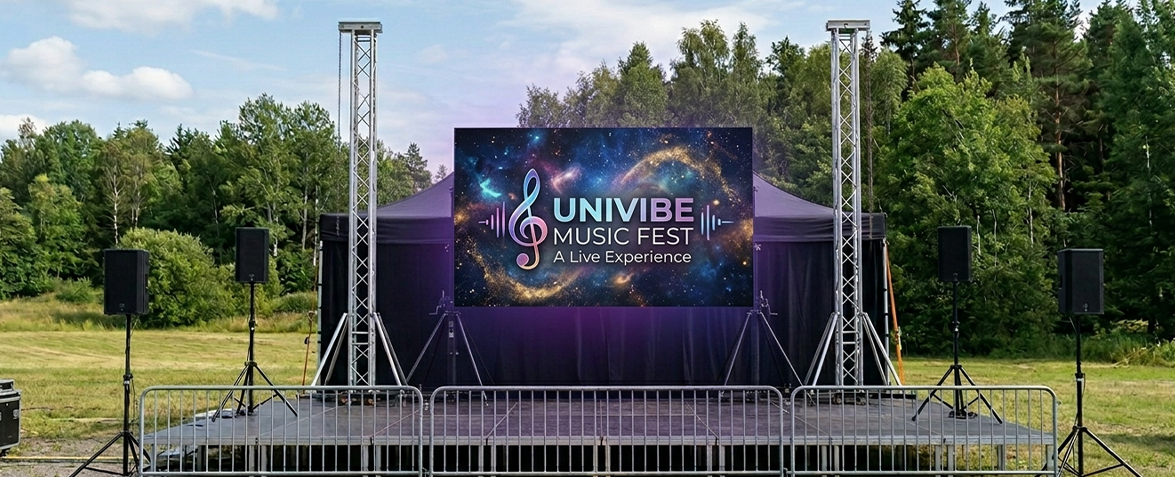
Panels are built upward from a base, often using interlocking cabinet systems. This is common for outdoor festival stages and event environments where ground rigging is more practical than aerial. The On Stage DP's pre-drilled 1/4-inch mounting holes and modular mix-and-match design make it well-suited for flexible stacking configurations.
One often-overlooked specification: serviceability access. Front-access panels can be maintained without any access to the rear — a critical feature for installations where the wall backs directly against a structural surface. All three Rasha panels offer front-service access, and the On Stage DP adds rear service access as well.
How Do the Three Rasha LED Panel Lines Compare — and Which One Is Right for My Project?

Here is an honest side-by-side look at the three LED display products from Rasha — Professional Stage Lighting and Video Wall Manufacturer — so you can match the right panel to the right application.
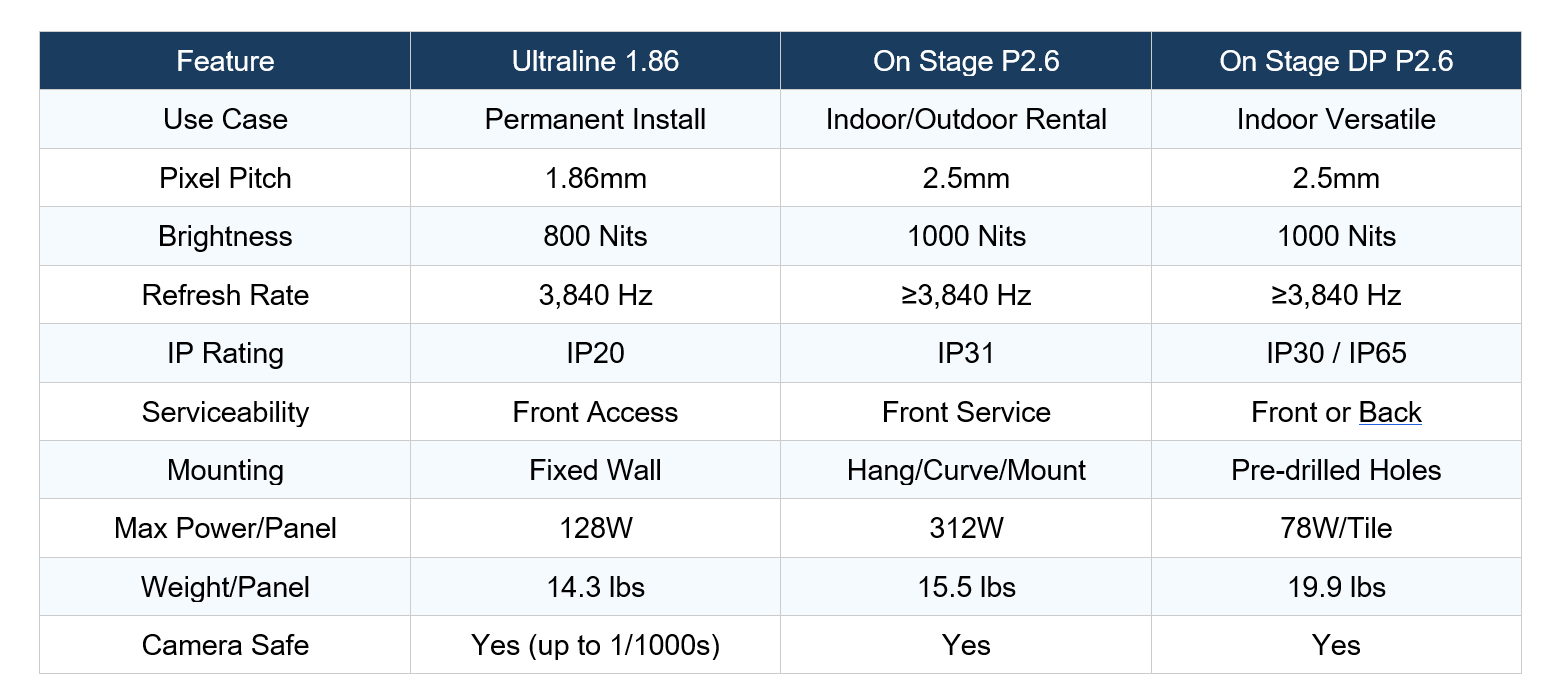
Ultraline 1.86 — The Permanent Install Standard
The Ultraline 1.86 is designed for spaces that want to install once and forget about it. Its 1.86mm pixel pitch delivers the finest detail resolution in the Rasha lineup, making it ideal for close-viewing environments. True black face panels mean the wall disappears into the architecture when off — no gray smear, no visible bezels. The closed-back, front-serviceable design requires zero rear clearance, which makes it possible to use in tight wall pockets where most LED products simply cannot fit.
Standard configurations resolve cleanly to 16:9 without partial cabinets — an 8x6 grid suits corporate lobbies, a 12x9 or 16x12 grid scales to ballrooms and event halls. The NovaStar A5s Plus receiving card provides HDR support and handles up to seven panels per port.
Learn more: Ultraline 1.86 — Permanent Indoor LED Video Wall
On Stage P2.6 — The Flexible Event and Rental Panel
The On Stage P2.6 is the most versatile panel in the lineup. Its die-cast aluminum cabinet supports hang, curve, and ground-stack configurations — concave and convex curving lets event designers build immersive curved backdrops, not just flat walls. At IP31 standard with IP65-capable modules, it bridges the gap between indoor stage use and covered outdoor event environments.
With 1,000 adjustable nits, a color temperature range of 4,000K to 9,500K, and 281 trillion color depth, the On Stage handles everything from warm theatrical lighting environments to bright daylight outdoor stages. Remote monitoring and control via NovaStar makes troubleshooting possible without physically accessing the wall — important at live events where downtime is not an option.
Learn more: On Stage P2.6 — Indoor/Outdoor LED Video Panel
On Stage DP — The Indoor Multi-Purpose Panel
The On Stage DP is built for professionals who need flexibility in a fixed-format panel. At 500mm x 1000mm per tile, it offers an unusually tall aspect ratio for its cabinet size — the 2x4 module grouping creates a panel that stacks efficiently for vertical applications like stage wings and portrait-format displays. The mix-and-match design means you can combine panels in non-standard configurations without gaps or mismatched pixel pitch.
Front and rear maintenance access, combined with push/pull module extraction, makes the On Stage DP the easiest panel in the lineup to service mid-installation. The dual IP30/IP65 rating adds outdoor capability without requiring a separate product.
Learn more: On Stage DP P2.6 — Indoor LED Video Panel
What Control System and Software Do I Need to Run an LED Video Wall?
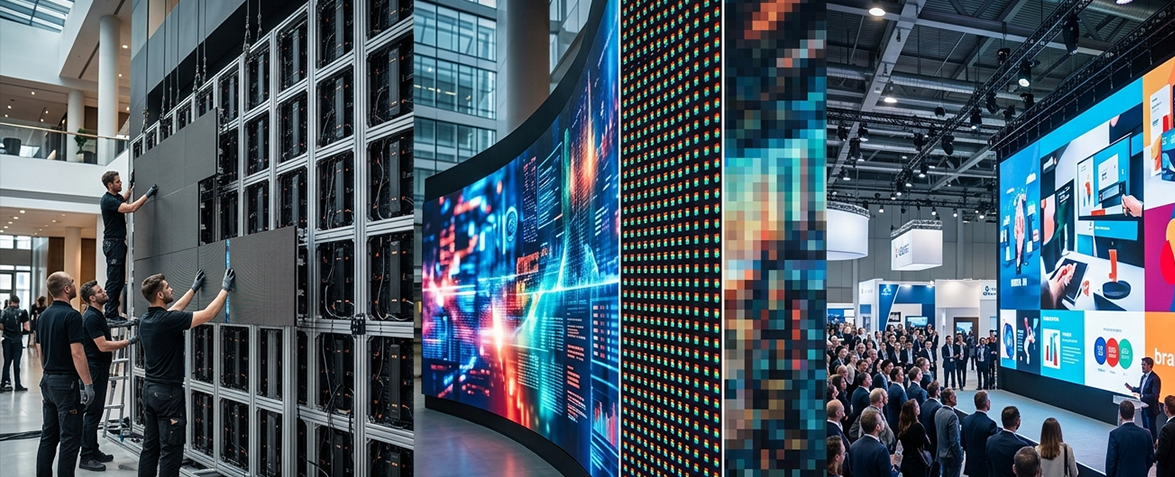
An LED video wall is only as good as the content management system driving it. All three Rasha panels use the NovaStar ecosystem — a widely supported, industry-standard LED control platform used by integrators globally.
NovaStar's software runs on both Windows and MacOS. The A5s Plus receiving card, used across all three Rasha panels, supports HDR content and handles up to seven panels per port. NovaStar's MCTRL series sending units manage multiple outputs simultaneously, making it straightforward to scale from a single wall to a multi-zone installation.
One critical feature: NovaStar supports virtual rotation, which means portrait-orientation content can be displayed on panels physically installed horizontally — software handles the rotation without any mechanical changes to the hardware. This is relevant for the Ultraline 1.86, which is designed for horizontal physical installation but supports vertical display through software.
For large-scale installations, NovaStar's remote monitoring allows operators to check panel status, brightness levels, and error reporting from off-site — useful for permanent installs in hotel lobbies or retail chains where an on-site technician is not always available.
When evaluating LED video wall systems, always ask whether the control system is proprietary or open. Proprietary systems lock you into one vendor for all future upgrades. NovaStar is an open ecosystem supported by hundreds of manufacturers and integrators worldwide.
What About Color Accuracy, Contrast, and HDR Support?
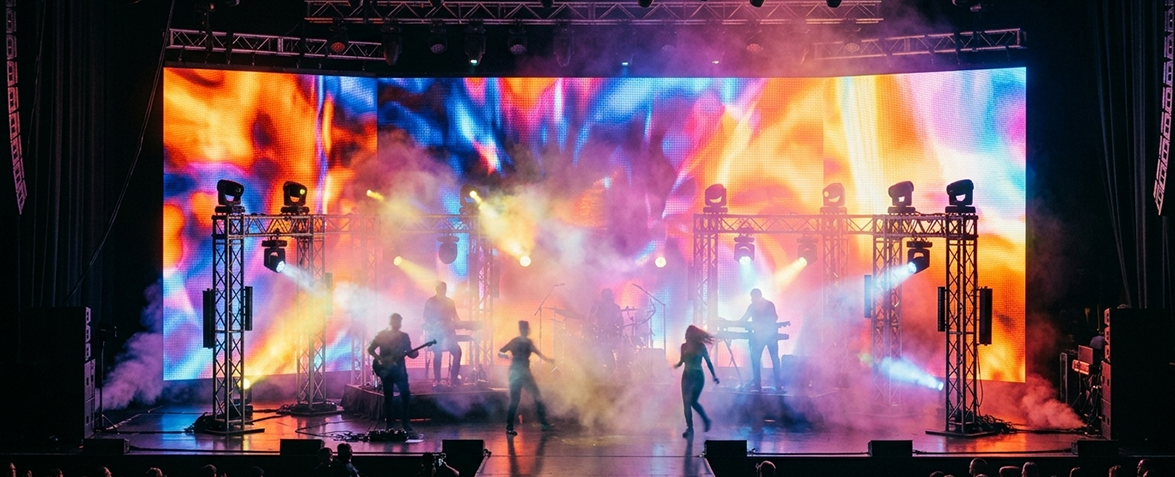
For most commercial video wall applications — digital signage, corporate communications, event backdrops — standard color reproduction is sufficient. But for brand environments, broadcast, cinema, and premium hospitality, color accuracy becomes a differentiating specification.
Color gamut is typically expressed as a percentage of a reference color space. The most common references are sRGB (the standard web/TV color space) and DCI-P3 (the cinema standard). The Ultraline 1.86 covers more than 93 percent of the DCI-P3 color space — significantly wider than standard sRGB displays, which makes it capable of reproducing the vibrant, saturated colors used in premium brand content and cinema-grade visuals.
Contrast ratio is the difference between the brightest white and the darkest black the display can produce simultaneously. The Ultraline 1.86's 10,000:1 contrast ratio — enabled by its true black face panel — means shadows retain detail and highlights stay punchy. This is the visual characteristic that separates premium LED from budget panels in side-by-side comparisons.
HDR (High Dynamic Range) support on the Ultraline 1.86, via the NovaStar A5s Plus receiving card, allows the wall to process and display HDR content natively. As more content creators work in HDR pipelines, this future-proofs the installation against content upgrades.
The On Stage panels offer adjustable color temperature (4,000K to 9,500K) and 12-bit color processing per channel (red, green, blue), which provides fine-grained control over color balance across different lighting environments — important for live event applications where ambient light varies throughout the day.
What Are the Hidden Costs and Long-Term Considerations Nobody Warns You About?
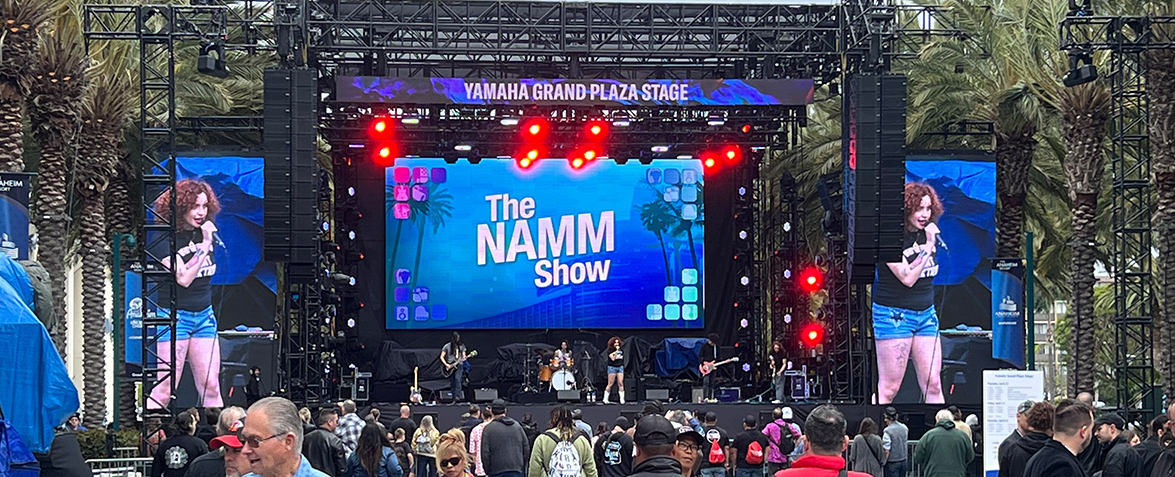
LED video walls are a significant investment — and the panel cost is only part of the total picture. Here are the factors that experienced buyers account for that first-timers often miss.
Structural Backing and Mounting Infrastructure
For permanent installs, the wall needs a proper structural backing — typically 3/4-inch plywood over a framed surface rated to hold the combined weight of the panels. A 48-panel Ultraline 1.86 wall weighs approximately 686 pounds (48 × 14.3 lbs). The wall surface needs to be engineered to handle that load safely.
Power Infrastructure
Dedicated circuits, appropriate gauge wiring, and properly rated breakers are not optional. Running a large LED wall on shared circuits is a fire hazard and a reliability problem. Budget for electrical work as a separate line item.
Signal Distribution and Processing
The NovaStar sending unit, cabling, and any signal processing equipment (scalers, video switchers, media servers) add to the total system cost. For large walls or multi-source inputs, this can be significant.
Content Creation and Management
An LED video wall without compelling content is just an expensive light fixture. Budget for content creation, a media server or player, and if needed, a content management system for scheduling and remote updates.
Ongoing Maintenance
LED panels do require periodic maintenance — module replacement, calibration, cleaning. Front-serviceable panels like all three Rasha models dramatically reduce the labor cost of maintenance by eliminating the need for rear access. LED lifespan is rated at 100,000 hours for the On Stage series — at 12 hours per day of operation, that is over 22 years of theoretical life before significant degradation.
Rasha — Professional Stage Lighting and Video Wall Manufacturer — supports buyers throughout the lifecycle with a demo-before-you-buy program, flexible financing options, dedicated technical support, and manufacturer warranty coverage. These are not afterthoughts — they are structural advantages that reduce the total cost of ownership compared to buying from a distributor with no post-sale support.
Why Buy from Rasha — Professional Stage Lighting and Video Wall Manufacturer?

There are hundreds of LED panel manufacturers and distributors in the market. The technical specifications on a datasheet tell you what a panel can do. What the datasheet cannot tell you is what happens after you buy.
Rasha differentiates on the post-purchase experience — and in LED video wall installations, that is where buyers win or lose.
Schedule a Demo Before You Buy — See the panels in real conditions before committing. Evaluate brightness, color, and build quality in person, not from a stock photo.
Flexible Financing — Apply for financing options that match your project's cash flow, whether you are a venue operator, an event production company, or a freelance AV integrator.
Technical Support — Dedicated technical support from a team that knows the product, not a third-party call center. Setup guidance, integration support, and troubleshooting.
Manufacturer Warranty — Covered directly by the manufacturer, not a warranty card buried in a box. When a module needs replacing, the process is streamlined.
Customer Service — Ongoing service relationship, not a one-time transaction. Rasha is a manufacturer with a stake in how their panels perform in the field.
Full Technical Specifications — Rasha LED Video Wall Products
Ultraline 1.86 — Key Specifications
Pixel Pitch
1.86mm
Panel Resolution
344 × 258 pixels
Brightness
800 nits
Refresh Rate
3,840 Hz
Color Gamut
>93% DCI-P3
Contrast Ratio
10,000:1
Viewing Angle
>160° H / >120° V
Cabinet Size (WxHxD)
25.19" × 18.89" × 1.89" (640 × 480 × 48mm)
Panel Weight
14.3 lbs (6.5 kg)
Max Power
128W / 1A @ 120V
Panels per 20A Circuit
16 panels
IP Rating
IP20
Serviceability
Front Access, Magnetic Modules
Control System
NovaStar A5s Plus
HDR Support
Yes
Camera Safe
Yes — Flicker-free at 24–60 fps, up to 1/1000s shutter
Operating Temp
14°F to 95°F (-10°C to 35°C)
Safety Certification
ETL Listed (Intertek)
On Stage P2.6 — Key Specifications
Pixel Pitch
2.5mm
Cabinet Resolution
192 × 192 pixels per tile
Tile Size
500 × 500 × 80mm
Brightness
1,000 nits (adjustable)
Refresh Rate
≥3,840 Hz
Color Depth
281 trillion colors
Color Temperature
4,000K–9,500K (adjustable)
IP Rating
IP31
Serviceability
Front Service, Magnetic Modules
Installation
Hang, Curve (Concave/Convex), or Mount
Max Power
312W / 2.6A @ 120V
Cabinet Weight
15.5 lbs (7.05 kg)
LED Life
100,000 hours
Control System
NovaStar A5S Plus
Operating Temp
14°F to 140°F (-10°C to 60°C)
On Stage DP P2.6 — Key Specifications
Pixel Pitch
2.5mm
Tile Size
500 × 1000 × 80mm
Cabinet Resolution
200 × 400 pixels per tile
Brightness
1,000 nits (adjustable)
Refresh Rate
≥3,840 Hz
Color Temperature
4,000K–9,500K (adjustable)
Viewing Angle
120° H / 110° V
IP Rating
IP30 / IP65
Serviceability
Front or Back Access
Max Power
78W / 0.70A @ 124V
Cabinet Weight
19.91 lbs (9.05 kg)
LED Life
100,000 hours
Control System
NovaStar A5S Plus
Mounting
Pre-drilled 1/4" mounting holes
Operating Temp
14°F to 140°F (-10°C to 60°C)
Final Thoughts: Match the Spec to the Space
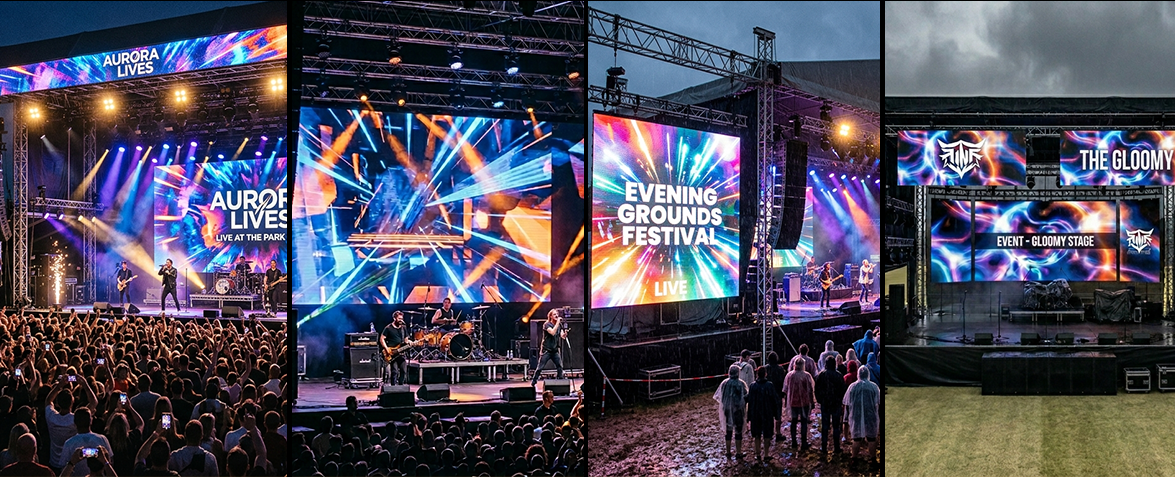
Buying an LED video wall is not about finding the most expensive panel or the highest number on a spec sheet. It is about matching the right specifications to the right environment, the right viewing distance, the right content, and the right operational requirements.
For permanent architectural installs in lobbies, restaurants, and boardrooms — the Ultraline 1.86 delivers fine-pitch clarity, true-black aesthetics, and a front-serviceable closed-back design that respects the architecture it lives in.
For live events, touring productions, and rental applications that move between indoor and outdoor environments — the On Stage P2.6 offers the installation flexibility, weather resistance, and remote monitoring that professional productions demand.
For multi-purpose indoor applications that require front- and rear-service access, portrait-friendly aspect ratios, and a dual IP rating that adds outdoor optionality — the On Stage DP is the answer.
All three products share a common control platform, common service approach, and the same manufacturer support structure from Rasha — Professional Stage Lighting and Video Wall Manufacturer — including demo scheduling, flexible financing, technical support, manufacturer warranty, and dedicated customer service.
Ready to spec your next LED video wall project? Visit rashaprofessional.com to schedule a demo, explore financing options, or speak with the technical team.
Everything You Need to Know About LED Video Walls — Answered
We've rounded up the most common questions buyers ask when specifying an LED video wall — from pixel pitch and brightness to power planning and product selection. Here are the straight answers, backed by real specs and industry standards.
Pixel pitch is the center-to-center distance between LEDs (measured in mm). Choose pixel pitch based on the minimum comfortable viewing distance: as a practical rule, minimum viewing distance in metres ≈ pixel pitch in mm (or use 1–1.5× pixel-pitch for conservative specs). For example, P1.86 ≈ 1.8–2.8 m; P2.6 ≈ 2.6–3.9 m.
Match brightness to ambient light: indoor controlled spaces 600–1,200 nits; semi-outdoor / covered areas 1,500–3,500 nits; fully outdoor daytime 4,000–7,000+ nits. Rasha indoor models (Ultraline 1.86) are optimized around 800 nits; On Stage series offer adjustable brightness to 1,000 nits and can be specified with higher-nit modules for bright venues.
Outdoor panels require higher brightness and weatherproofing (IP65 minimum for permanent exposed installs). Indoor panels trade weatherproofing for finer pixel pitches and lower brightness. If you plan temporary outdoor use (covered events), choose a rental-capable panel with IP-rated modules or a hybrid model like Rasha On Stage P2.6 with IP65-capable modules.
For permanent outdoor exposure use IP65 front-face. For covered or semi-outdoor situations IP54–IP55 may be sufficient. For coastal or ground-level flood risk consider IP67. Rasha’s On Stage DP can be configured for IP65 in outdoor-capable module builds.
For any camera-visible environment specify ≥3,840 Hz refresh rate to avoid camera rolling/bar artifacts at common shutter speeds. All Rasha panels (Ultraline 1.86, On Stage P2.6, On Stage DP) are rated to meet broadcast-safe refresh performance.
se the panel max-power spec and the 80% continuous-load rule. Example reference (use actual panel max-power when quoting): Ultraline 1.86 ≈ 128W/panel (~1A @120V) → ~16 panels per 20A circuit at 80% load; On Stage P2.6 ≈ 312W/panel → ~6 panels per 20A circuit. Always confirm with a licensed electrician.
Typical LED lifetime is rated ~100,000 hours to 50% brightness; practical refresh decisions often happen in 10–15 years depending on usage and environment. Choose front-serviceable panels for installations where rear access is impossible; Rasha panels offer front service across the lineup and rear access on On Stage DP. Budget for periodic module replacement, calibration, and cleaning.
Prefer an open, widely supported control ecosystem. Rasha panels use the NovaStar A5s Plus receiving card and NovaStar sending units, a broadly supported platform that simplifies integration, HDR support, and remote monitoring. Confirm compatibility with media servers and switchers used on your event or installation.
Rasha offers three demo options — showroom, virtual, and on-site where available — to evaluate color, brightness, and serviceability. Financing is available for qualified buyers; the manufacturer provides direct warranty and technical support. Contact Rasha sales to schedule a demo or request lead-time estimates. Phone: +1 (951) 654-3585,
Short guide: Ultraline 1.86 — permanent indoor installs and close-view lobbies (fine pitch, true black, front service). On Stage P2.6 — rental and event use, modular hang/curve, IP65-capable modules for covered outdoor. On Stage DP — versatile indoor with front or rear service and optional outdoor-capable configuration. Use viewing distance, ambient light, and service/access needs to pick one.
Account for structural backing, dedicated electrical circuits, signal processing (sending units, scalers, media servers), content creation, and ongoing maintenance. Structural and electrical work is often 20–40% of installed cost depending on wall size. Always specify serviceability (front access) where possible to lower long-term maintenance labor.
Tyler Hayes
With over 15 years in the entertainment lighting scene, Tyler Hayes has helped shape unforgettable live experiences across stages, clubs, and festivals. He writes about how lighting transforms moments into lasting memories. His passion lies in inspiring others to see light not just as illumination, but as the heartbeat of every great event.
Related posts
.png&w=1080&q=75)
Posted on 05/02/2026
LED Video Wall Guide: Setup, Pixel Pitch & ROI
An LED Video Wall is no longer just a display—it’s a performance tool that drives visibility, engagement, and revenue. From live e



