Posted on 11/17/2026
Outdoor Event Lighting in Cold Weather: What Cold Does to LED Fixtures
Quick answer: LED fixtures handle cold well, as long as you stay inside the fixture's rated operating temperature. The cold itself is rarely what stops a winter rig. Condensation, stiff cables, snow around ground fixtures and heaters on the same circuit are what cause trouble. Check the rating against the overnight low, let cold fixtures warm up before you power them indoors, keep connections off the ground and plan power for the heaters too.
Key points
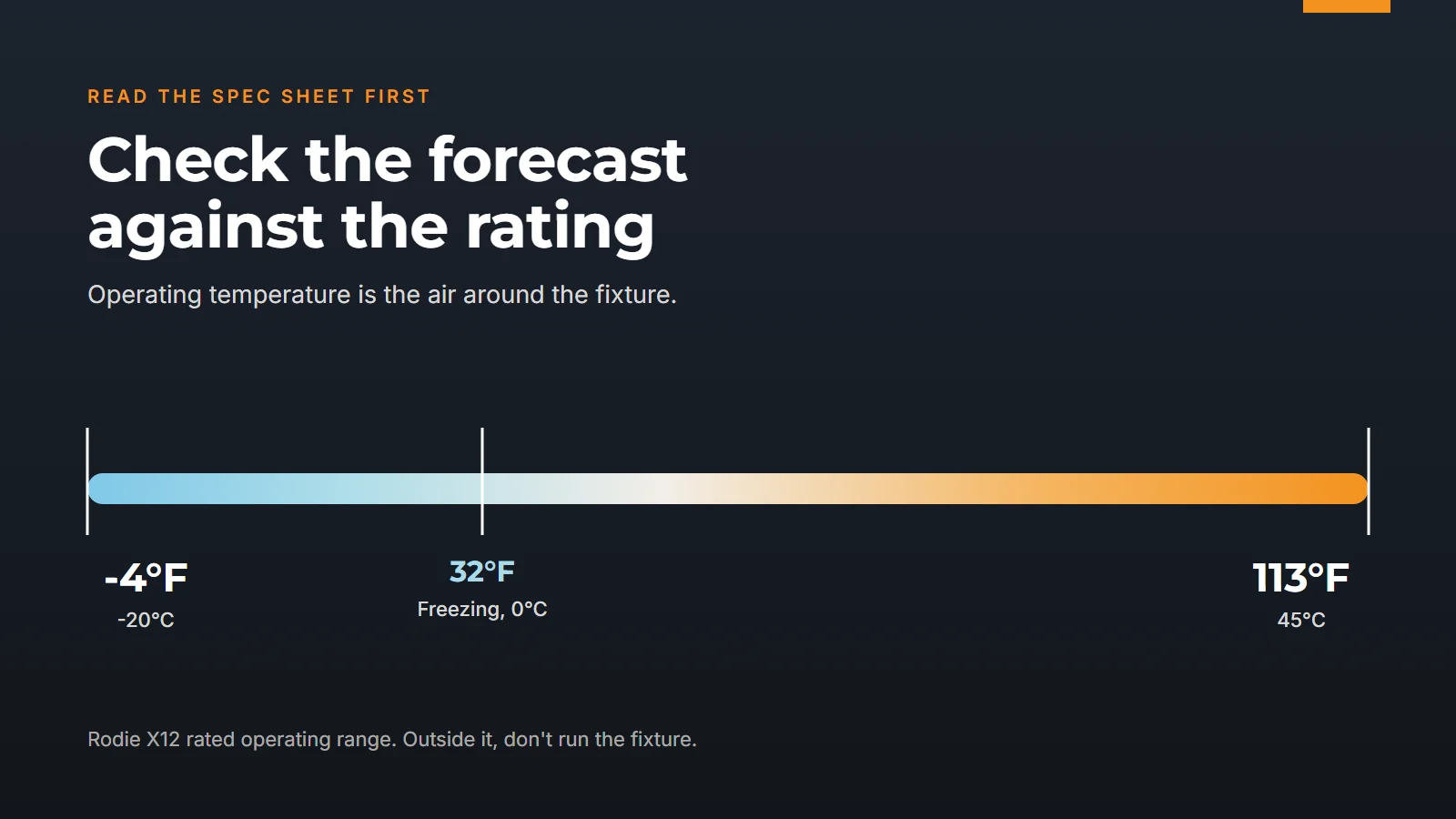
Check the rating: operating temperature is the air around the fixture. The Rodie X12 is rated from -4°F to 113°F (-20°C to 45°C).
Condensation is the bigger risk: a cold fixture carried into a warm, damp room collects water on and around it.
IP65 covers rain and snow: it is dust tight and protected against water jets, but it is not made to sit in standing water or slush.
Cables stiffen: uncoil them while they are warm and keep every connection off the ground.
Heaters eat power: one 1,500 W heater draws 12.5 A at 120 V, most of a 20 A circuit.
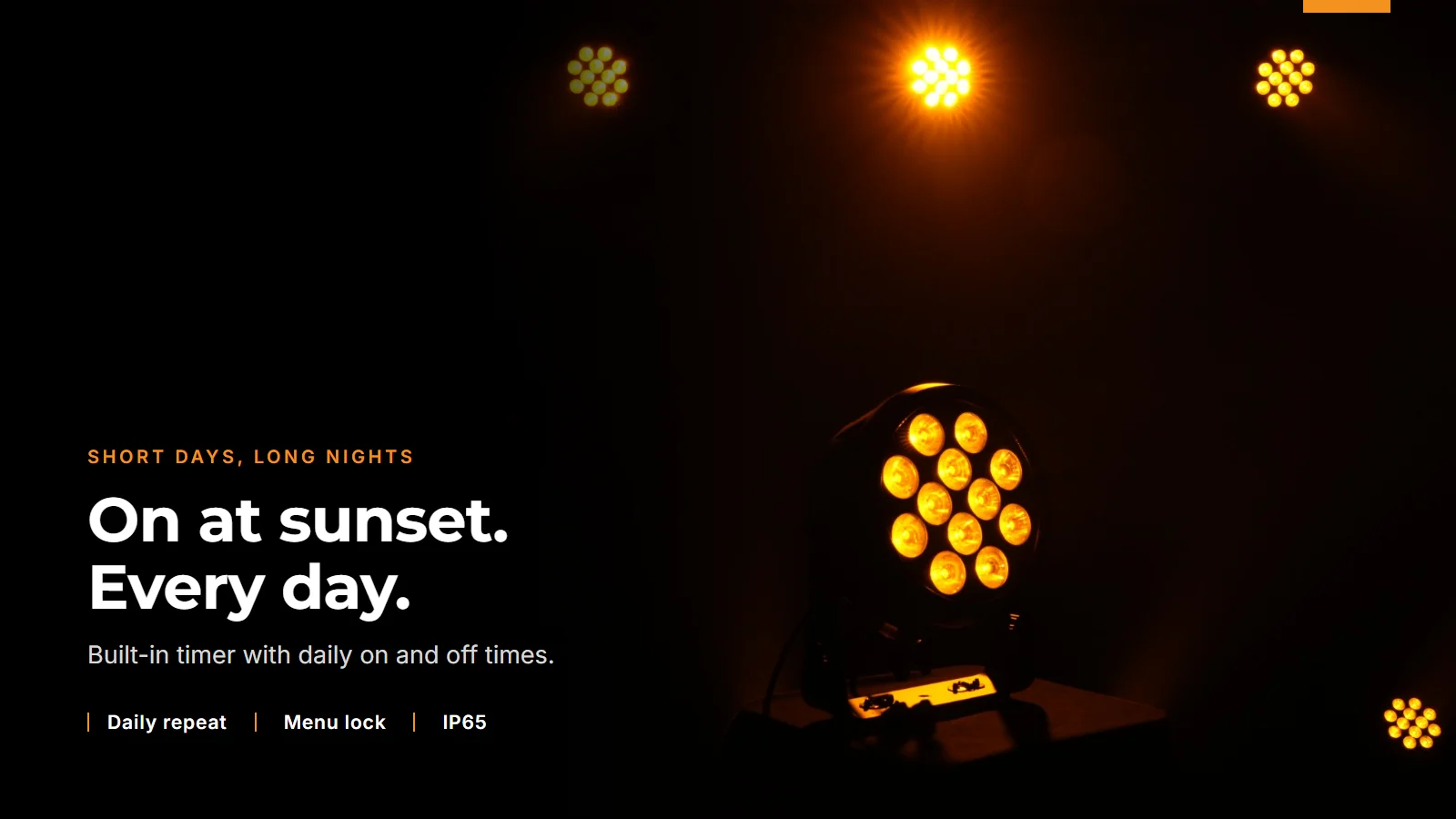
Days are short: a built-in timer turns lights on before dark without anyone on site.
Do LED lights work in cold weather?
Yes. The LED chips themselves like the cold. They run cooler, which is easier on them than a hot summer night. The limit comes from the rest of the fixture: the power supply, the electronics, the seals and the cables. That is why every fixture has a rated operating temperature, and why you plan around that number, not around the LEDs.
When a fixture is run below its rating, the usual problems are slow or uneven starts, flicker, or a fixture that won't power up at all. Inside the rating, it should behave the same as it does indoors. If you are not sure, power the rig up on site a few hours before doors and watch it, so you find a problem while there is still time to fix it.
What does operating temperature mean on a spec sheet?
Operating temperature is the range of air temperature the fixture is designed to run in. It is not the temperature of the housing or the LEDs. For an outdoor event, compare it to the lowest temperature you expect while the lights are on, which is usually late at night, not when you load in.
The Rodie X12 is rated to run from -4°F to 113°F (-20°C to 45°C). Here is a simple way to read a winter forecast against that:
Overnight low | What to plan for |
|---|---|
Above 32°F (0°C) | Rain and wet ground. Focus on keeping connections dry. |
32°F to 14°F (0°C to -10°C) | Ice, frozen slush and stiff cables. Lay cable before it freezes and raise ground fixtures. |
14°F to -4°F (-10°C to -20°C) | Still inside the X12's rating. Give the crew extra time, since gloves slow every step. |
Below -4°F (-20°C) | Outside the X12's rated range. Don't run it there. |
The X12 also shows its own internal temperature in the menu, so you can check how a fixture is doing during a long cold night.
Why is condensation a bigger risk than cold?
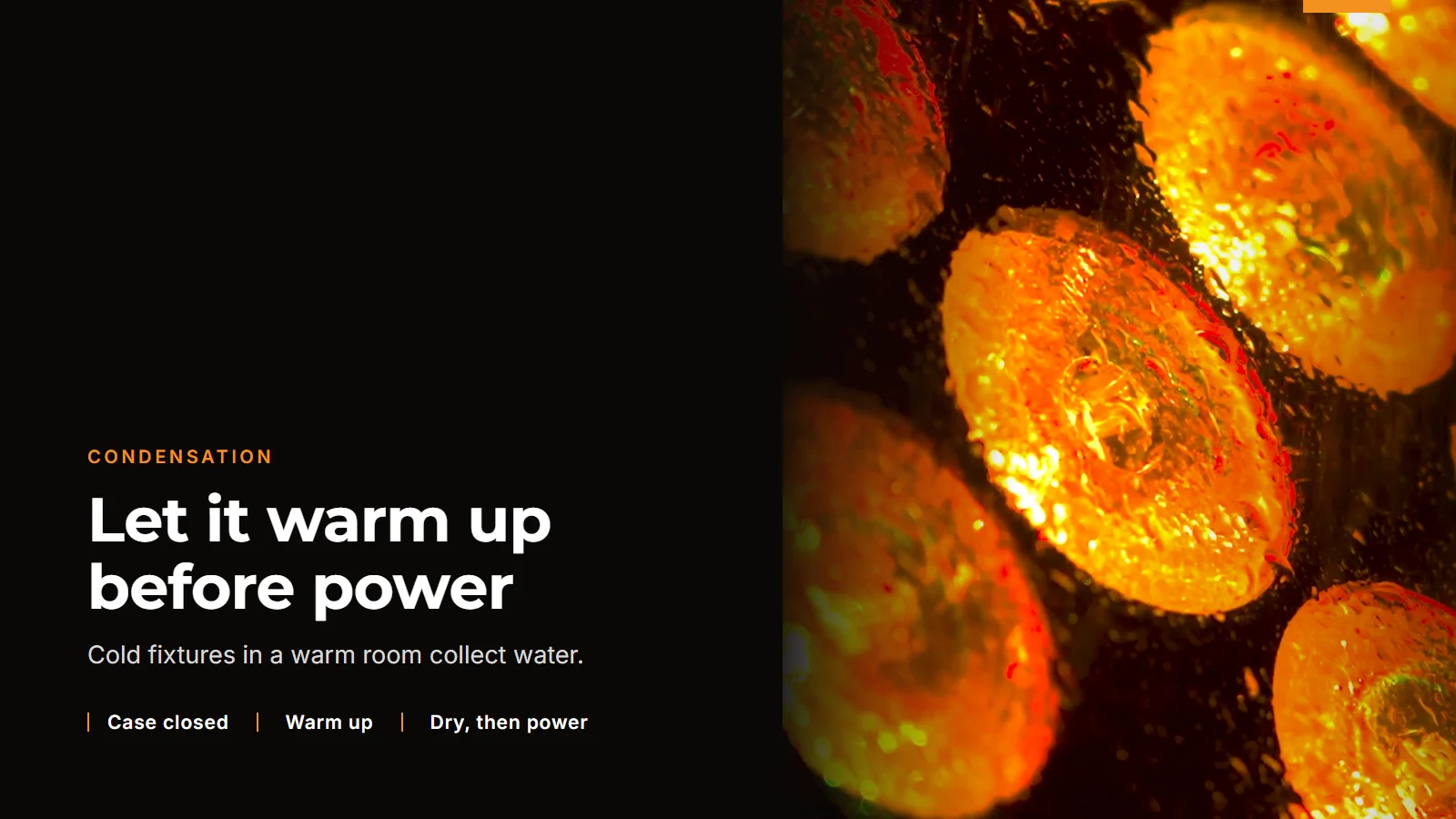
Condensation happens when cold metal meets warm, humid air. It is the same reason a cold drink gets wet on a summer day. In winter, it happens when fixtures come off a cold truck into a warm ballroom, or when a tent is heated after the lights have been sitting in the cold all afternoon.
The water forms on the housing, the lens and the connectors, which is exactly where you are about to plug in power. To avoid it:
Keep the case closed. Bring cold fixtures inside in their road case and leave it shut. The case lets the fixture warm up slowly, so water forms on the case instead of the fixture.
Give it time. A full case can take an hour or more to warm through. If a fixture still feels cold or looks wet when you open it, wait.
Dry before power. Wipe down the housing and look at the connectors before you plug anything in.
Reverse it at load-out. Let warm fixtures cool and dry before you close them into cases outside. Closing a warm, damp fixture into a cold case traps the moisture in with it.
Is IP65 enough for snow and rain?
For rain and blowing snow, yes. IP65 means the fixture is dust tight (the 6) and protected against water jets from any direction (the 5). That covers rain, wet snow and a hose-down.
IP65 does not cover sitting in water. A fixture on the ground can end up in a puddle of melted snow, or buried in a drift or a pile from a snow shovel. A few simple habits help:
Raise ground fixtures. Put uplights on a small riser or base so meltwater runs under them, not into the connectors.
Clear the lens. Snow on the lens blocks the light. Brush it off between sets.
Mind the de-icer. Salt from sidewalks gets kicked onto nearby fixtures. Wipe them down after the event.
Tighten before it freezes. Set the aim and lock the yoke knobs during setup. Cold knobs are hard to turn with gloves on.
On the Rodie X12, IP65 runs from the lens to the locking power connectors. It uses passive cooling, so nothing pulls cold, wet air into the fixture.
What happens to cables and connectors in the cold?
Cable is often the first thing to give you trouble. Many standard PVC jackets get stiff below freezing and can crack if you bend them hard. Rubber-jacketed cable stays more flexible. Either way:
Uncoil while warm. Lay out cable before it has sat in the cold, or warm it inside first. A frozen coil fights you all the way.
Keep connections off the ground. Lift every joint out of snow, slush and puddles, and cover any connection that is not rated for outdoor use.
Use outdoor power. Outdoor outlets usually need GFCI protection under local code. Ask the venue or your electrician before the event.
Protect walkways. Use cable ramps where people walk. Ice and cable together make an easy place to fall.
The X12 uses locking IP65 power connectors for both input and through, so power links fixture to fixture with sealed connections. Make sure each one is pushed in and locked before the weather turns.
How do you plan power when heaters are on site?
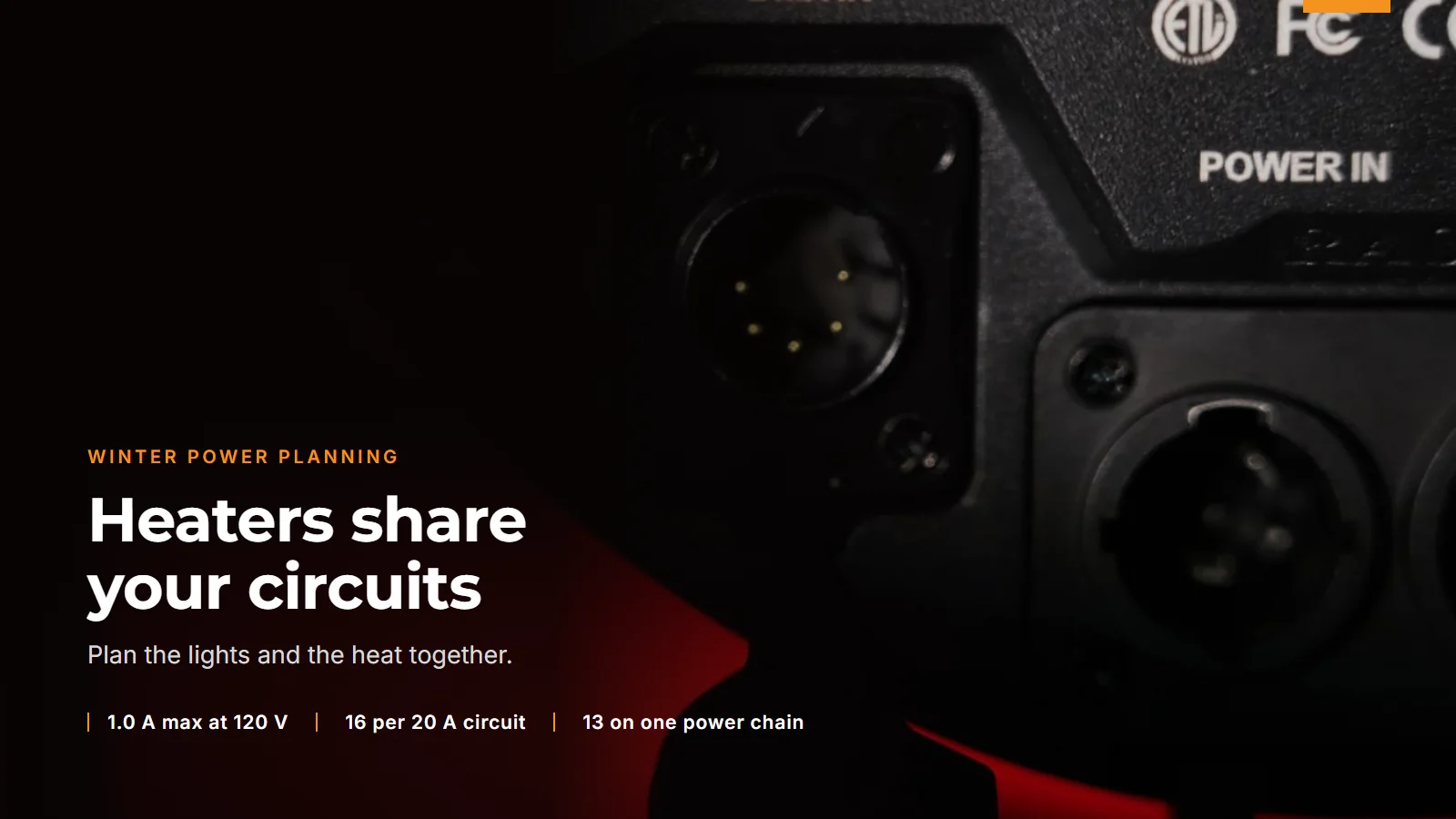
Winter events bring heaters: patio heaters, tent heaters, space heaters at the check-in table. A common 1,500 W electric heater draws 12.5 A at 120 V. On a 20 A circuit kept at 80% load (16 A), that leaves only 3.5 A for anything else. Put lights and heaters on separate circuits and label them.
LED fixtures help here because they draw so little. The Rodie X12 uses 124 W, 1.0 A at most at 120 V, and about 12 W idle. That works out to:
16 fixtures on one 20 A circuit at 120 V, at 80% load.
13 fixtures on one linked power chain at 120 V, based on the 13 A power through rating.
The X12 takes 100 to 240 VAC, so the same fixture works on either service. These numbers are calculated from the manual's maximum draw, so check them against the venue's power and local code.
How do you handle short days and long setups?
In much of the US, December sunsets come before 5:00 p.m. For a holiday market, a tree display or lighting a building for the season, someone has to turn the lights on every evening and off every night, often in the cold.
A fixture with a built-in timer does that for you. The Rodie X12 has a clock with daily on and off times and a daily repeat. At the off time it goes to standby with the dimmer at zero. For semi-permanent setups that stay up for weeks, two more settings are worth using:
Menu lock. Locks the buttons so passersby can't change settings. Hold UP and DOWN together for 5 seconds to unlock.
Display timer. Turns the display off after a set time so it doesn't glow all night.
One more thing for daytime: the X12 manual warns against letting direct sunlight shine into the front lens, including during long outdoor idle periods. The winter sun sits low in the sky, so check where it falls on your fixtures during the day. Aim them away from it or cover the lenses until the show.
Cold-weather setup checklist
Check the overnight low against every fixture's operating temperature.
Plan separate circuits for lights and heaters, and label them.
Lay out cable while it is warm. Lift every connection off the ground.
Raise ground fixtures above where snow and meltwater will collect.
Lock connectors and yoke knobs before temperatures drop.
Set timers, menu lock and addresses before you leave the fixtures alone.
Power up a few hours before doors and watch the whole rig.
At load-out, let fixtures cool and dry before you close the cases.
Back indoors, keep the cases closed until the gear warms up.
Rodie X12 outdoor specs at a glance
Spec | Rodie X12 |
|---|---|
Operating temperature | -4°F to 113°F (-20°C to 45°C) |
IP rating | IP65, from the lens to the locking power connectors |
Cooling | Passive |
Power | 100 to 240 VAC; 124 W, 1.0 A max at 120 V; about 12 W idle |
Power through | 13 A at 120 V, 16 A at 240 V |
Control | DMX and RDM, 7 DMX modes, NFC app |
Timer | Built-in clock, daily on and off times, daily repeat |
White light | 83 presets from 1,800K to 10,000K; CRI 96+, R9 90+ (2,500K to 10,000K) |
Weight | 10 lb (4.6 kg) |
Rigging | Quarter-turn omega bracket or M10 clamp, any orientation, rear safety cable point |
Where this matters
Holiday markets and tree lightings. Lights on at dusk every night for weeks, with nobody there to flip a switch.
Building and facade lighting for the season. Semi-permanent uplighting that stays out through snow and rain. See event lighting.
Winter weddings and tented receptions. Fixtures go from a cold truck into a heated tent, which is where condensation catches people out.
New Year's Eve and outdoor concerts. Long nights, heaters for the crowd and a crew working in gloves.
Outdoor services and live nativity scenes. Warm white that looks right on people and on camera, from 1,800K up. See house of worship lighting.
Plan your winter rig with Rasha
Tell us where the event is, how long the lights stay up and what power you have. We'll help you work out the fixtures and the circuits.
Book a demo with the Rasha team
Find a Rasha reseller near you
Contact Rasha, or call +1 (951) 654-3585
Full specs and the manual are on the Rodie X12 product page.
Related reading
Frequently asked questions
Quick answers about running LED lights at outdoor events in cold weather.
Yes, as long as the air temperature stays inside the fixture's rated operating range and the fixture is rated for outdoor use. The LED chips handle cold well. The power supply, seals and cables set the limit, so check the spec sheet against the overnight low.
The Rodie X12 is rated to run from -4 degrees F to 113 degrees F (-20 degrees C to 45 degrees C). Below -4 degrees F it is outside its rated range and should not be run.
Cold inside the rated range is not the main risk. Condensation is. When a cold fixture is carried into a warm, humid room, water forms on the housing, lens and connectors. Keep it in its closed case until it warms up, and dry it before you connect power.
Leave it in its closed road case until it reaches room temperature. A full case can take an hour or more. If the fixture still feels cold or looks wet when you open it, wait longer.
IP65 means dust tight and protected against water jets from any direction, which covers rain and blowing snow. It does not cover sitting in standing water, so raise ground fixtures above where snow and meltwater collect.
At 120 V the X12 draws 1.0 A at most, so 16 fixtures fit on a 20 A circuit at 80 percent load. On one linked power chain, plan 13 fixtures at 120 V, based on the 13 A power through rating. Keep heaters on separate circuits.
Yes. It has a built-in clock with daily on and off times and a daily repeat. At the off time it goes to standby with the dimmer at zero. A menu lock keeps people from changing settings.

Tyler Hayes
With over 15 years in the entertainment lighting scene, Tyler Hayes has helped shape unforgettable live experiences across stages, clubs, and festivals. He writes about how lighting transforms moments into lasting memories. His passion lies in inspiring others to see light not just as illumination, but as the heartbeat of every great event.



