Posted on 10/19/2026
What to Look for in an LED Wash Light: 10 Features That Matter
Quick answer: When you buy an LED wash light, check ten things: the color engine, color rendering (CRI), the white range, the IP rating, how it is cooled, the beam angle, how it looks on camera, the control options, the power draw and the rigging. The Rodie X12 from Rasha Professional was built around this list: six colors in every LED, CRI 96+, white from 1,800K to 10,000K, an IP65 housing with no fans, and 124W at full output.
A spec sheet can run two pages, and most of it won't tell you how a fixture will work on your stage. Whether you light a church, run a rental shop, or book fixtures for weddings and concerts, these are the ten specs we tell people to read first. For each one, we explain what it means in plain English, what a good number looks like, and how the Rodie X12 handles it.
Key takeaways
Which colors matter more than how many. Amber, cyan and lime help a wash hit pastels and in-between shades.
Look for CRI 90 or higher if people or products will be lit in white. The Rodie X12 measures CRI 96+ with R9 90+.
IP65 and passive cooling let one fixture work indoors, outdoors and in quiet rooms.
Do the math on a full rig. Power, weight and rigging time add up across twenty or forty fixtures.
1. A color engine that can hit the color you pick
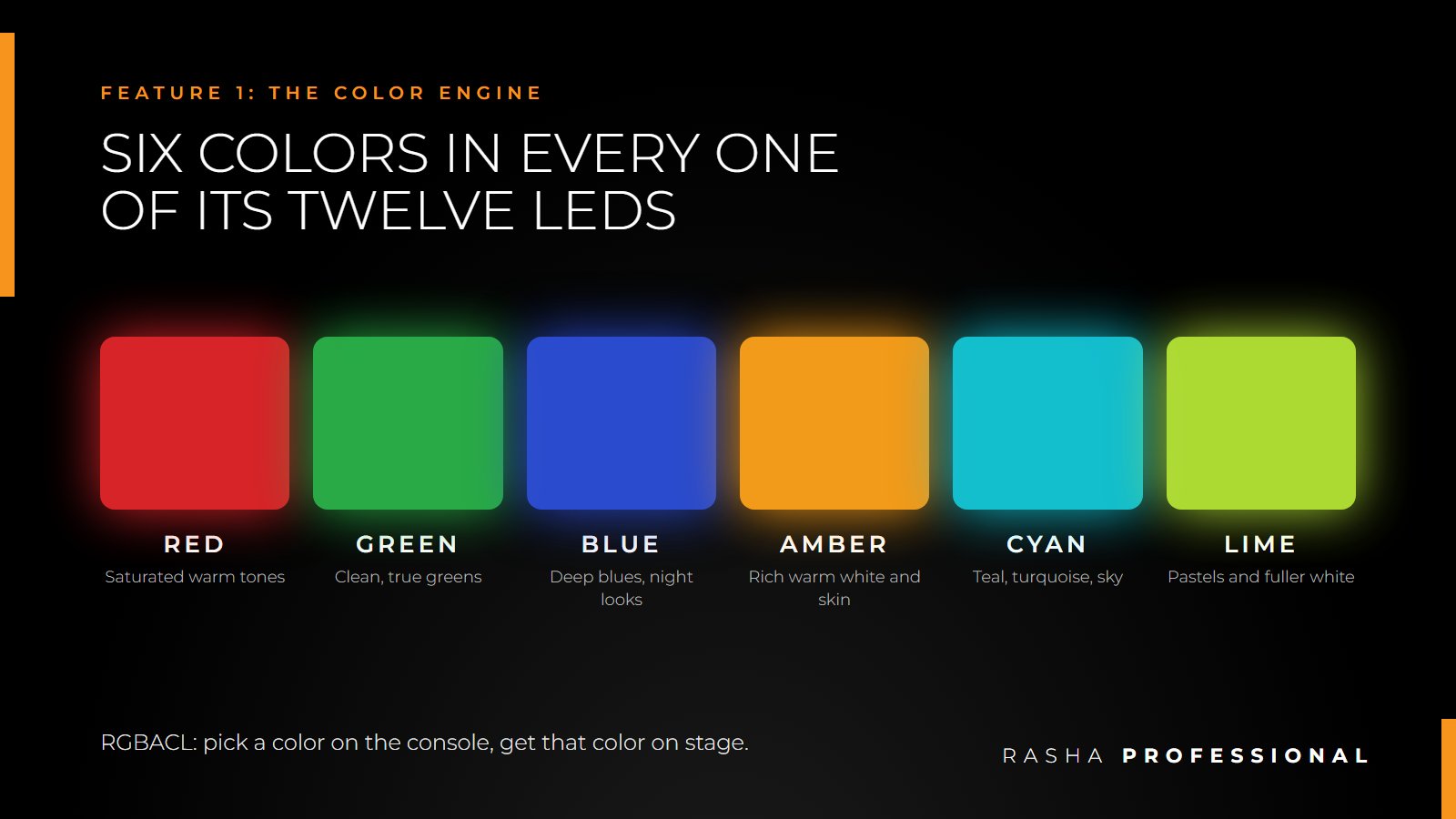
What to look for: The LED colors inside the fixture, often written as letters like RGBW or RGBACL. Basic RGB fixtures struggle with soft tints, warm skin-friendly tones and true turquoise. Extra colors fill those gaps, but only if they are mixing colors.
How the Rodie X12 handles it: Each of its twelve LEDs carries all six colors: red, green, blue, amber, cyan and lime (RGBACL). Amber warms the mix, cyan reaches teal and sky blue, and lime fills out pastels and white. Pick a color on your console's color picker and you get that color on stage.
2. High color rendering (CRI 90 or higher)
What to look for: CRI (color rendering index) tells you how natural things look under the light, on a scale up to 100. For anything with skin, wardrobe, flowers or products in it, look for CRI 90 or higher. Also check R9, which measures how well the light shows deep reds. Low R9 makes skin look gray or flat.
How the Rodie X12 handles it: CRI 96+ and R9 90+, measured from 2,500K to 10,000K. It also lists TM-30 Rf 90+ (with Rg 100 ±3) and TLCI 90 ±6, the camera-focused color score. In practice, that means faces, wood tones and fabric read the way people expect, live and on video.
3. Tunable white across a wide range
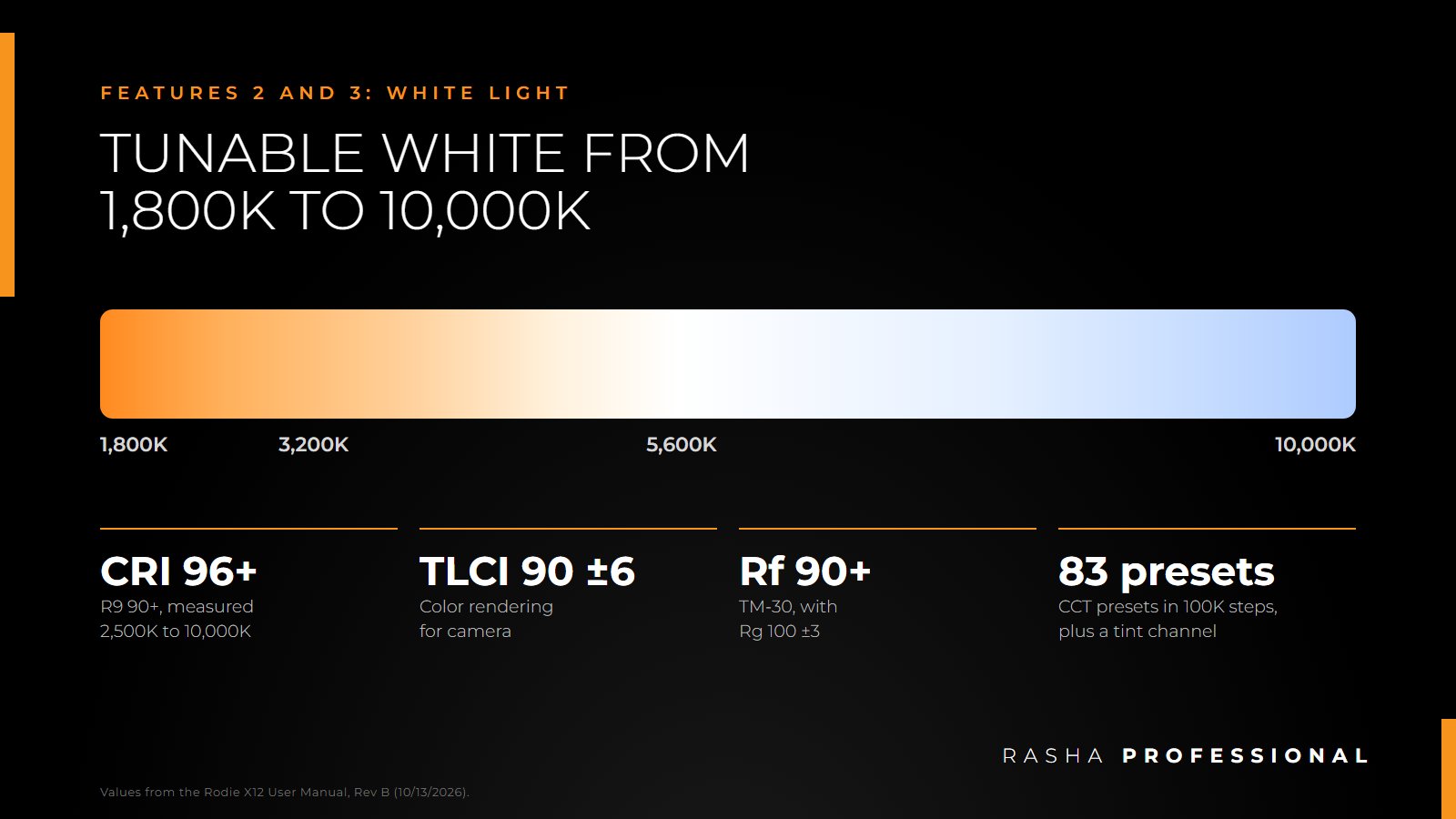
What to look for: Color temperature, measured in Kelvin (K). Lower numbers are warm (candlelight is around 1,800K, tungsten stage light around 3,200K) and higher numbers are cool (daylight is around 5,600K). A wide range lets one fixture match a warm ballroom, a daylight camera setup or a cool night look.
How the Rodie X12 handles it: White runs from 1,800K to 10,000K, with 83 color temperature presets in 100K steps. The larger DMX modes add a tint channel to push the white toward magenta or green, so you can match other fixtures or a camera's white balance. The white is built from all six colors working together, and you can push it warmer or cooler right from the console.
4. An IP rating that matches where you'll use it
What to look for: The IP (ingress protection) rating tells you how well the fixture is sealed against dust and water. IP20 is indoor only. IP65 means dust-tight and protected against water jets, which is what you want for outdoor events. Check the connectors too: a sealed fixture with open power plugs is not a sealed system.
How the Rodie X12 handles it: IP65 from the lens to the locking IP65 power connectors, input and through. It operates from -4°F to 113°F (-20°C to 45°C). It is suited for semi-permanent outdoor use: a festival weekend, an amphitheater season, a holiday building wash, or any outdoor job with an end date. Make all power and data connections in dry conditions.
5. Cooling that won't be heard
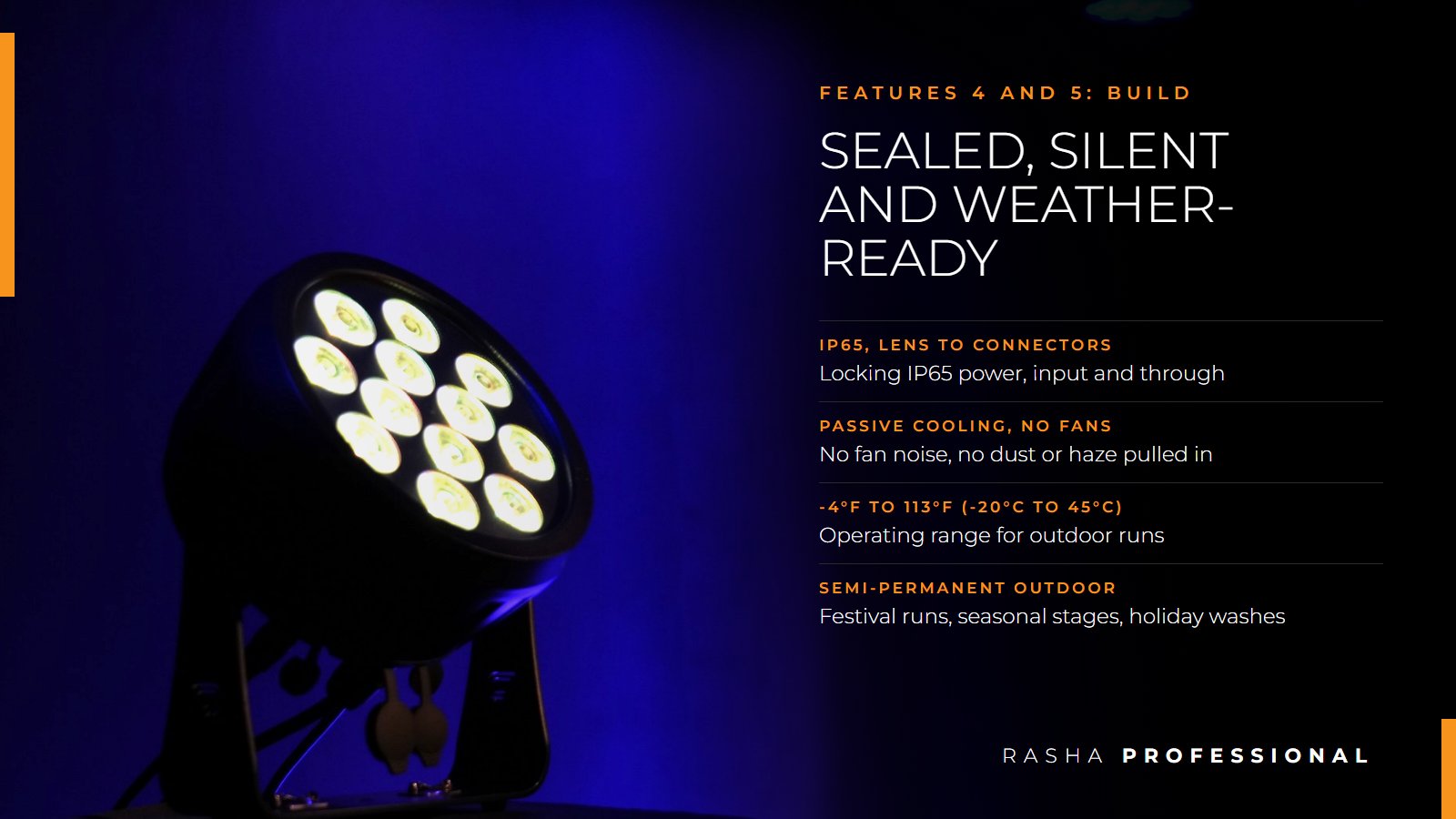
What to look for: How the fixture gets rid of heat. Fans move air, and that air brings noise plus dust and haze into the fixture. For churches, theaters, studios and speaking events, fan noise is easy to hear in the quiet moments.
How the Rodie X12 handles it: Passive cooling through a die-cast aluminum housing, with no fans. Nothing pulls in dust or haze, and no fan noise reaches the room or the microphones.
6. A beam angle built for washing (that can also key)
What to look for: Beam angle is where the light is at 50% of its center brightness. Field angle is where it falls to 10%. A narrow beam (10 to 15 degrees) makes a tight punch of light. A wider beam covers more stage or wall from the same spot, which is what a wash light is for.
How the Rodie X12 handles it: Each LED sits behind a fixed 25° lens. Measured at 5 m, that gives a 20° beam and a 36° field. It is a wash light that also keys: wide enough for an even stage or wall wash and for uplighting, and clean enough in white to light a performer or a speaker.
7. Smooth dimming and good behavior on camera
What to look for: If anything you light is filmed or livestreamed, check the PWM (pulse width modulation) frequency. Low PWM rates can show up as flicker or rolling lines on phone and video cameras. Also check the dimming resolution: 16-bit dimming fades smoothly at the bottom of the curve, where 8-bit can step.
How the Rodie X12 handles it: PWM is selectable at 800, 1,200, 2,000, 3,600, 12,000 or 25,000 Hz. For camera work, start at 12,000 or 25,000 Hz. The 20- and 25-channel modes give 16-bit control of the dimmer and every color, and you can pick from four dimmer curves (linear, square law, inverse square law and S-curve) to match the fixtures around it.
8. Control options for every kind of user
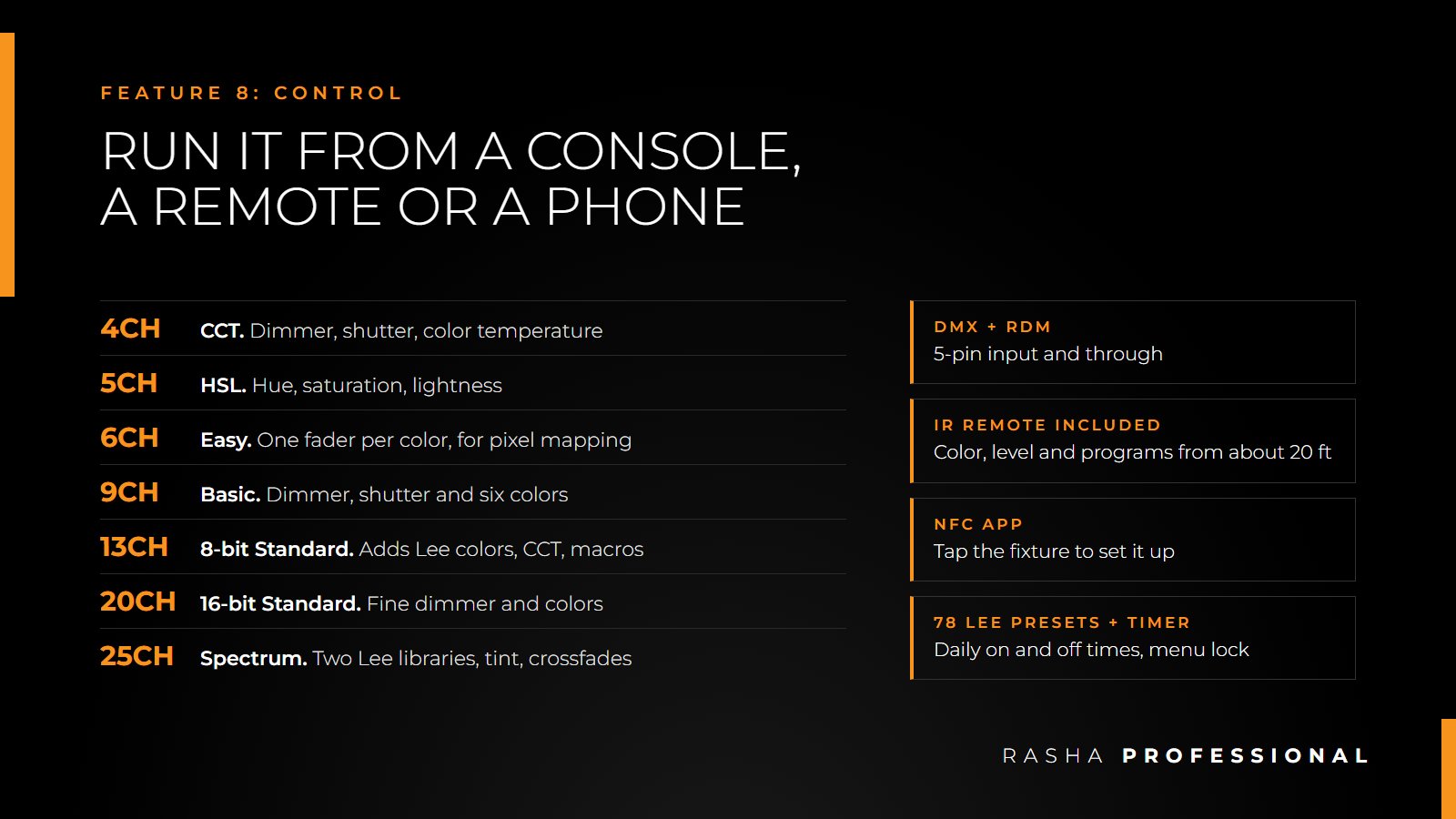
What to look for: The DMX modes (how many console channels the fixture uses), RDM support (so you can address and check fixtures from the console), and simpler options for people who don't run a console, like a remote or built-in presets.
How the Rodie X12 handles it:
Seven DMX modes: 4ch CCT, 5ch HSL, 6ch Easy, 9ch Basic, 13ch 8-bit Standard, 20ch 16-bit Standard and 25ch Spectrum, over 5-pin DMX with RDM.
IR remote in the box for color, level and programs from about 20 feet away.
NFC app to set up the fixture by tapping it with a phone.
78 Lee filter presets, so a designer can call up familiar gel colors by name.
Built-in timer with daily on and off times, plus a menu lock. That's handy for a lobby, a storefront or a holiday display that should run itself.
9. Power draw you can plan around
What to look for: Maximum watts and amps per fixture, the input voltage range, and how much power you can pass from one fixture to the next (pass-through or power linking). Multiply by your fixture count. That number decides how many circuits, how much cable and how big a generator you need.
How the Rodie X12 handles it: 124W (1.0A) maximum at 120V and 12W at idle. Input is 100 to 240 VAC, auto-ranging. Power pass-through is rated at 13A at 120V and 16A at 240V, and Rasha recommends a 20A breaker. For example, twenty fixtures at full output draw about 20A at 120V. Plan your runs from these figures and your local electrical code.
10. Weight and rigging that save time at load-in
What to look for: The fixture weight, how it mounts to truss or pipe, and whether it can sit on the floor. Every extra pound and every extra bolt gets multiplied across the rig and the crew's day.
How the Rodie X12 handles it: It weighs 10 lb (4.6 kg). It comes with a quarter-turn omega bracket (slots 108 mm apart), has an M10 clamp hole in the yoke, and has a safety cable point on the rear. Pressure-locking knobs hold the aim. It can be installed in any orientation, and four rubber feet let it sit on the deck for uplighting. The OLED display flips 180° when the fixture hangs upside down.
The LED wash light checklist
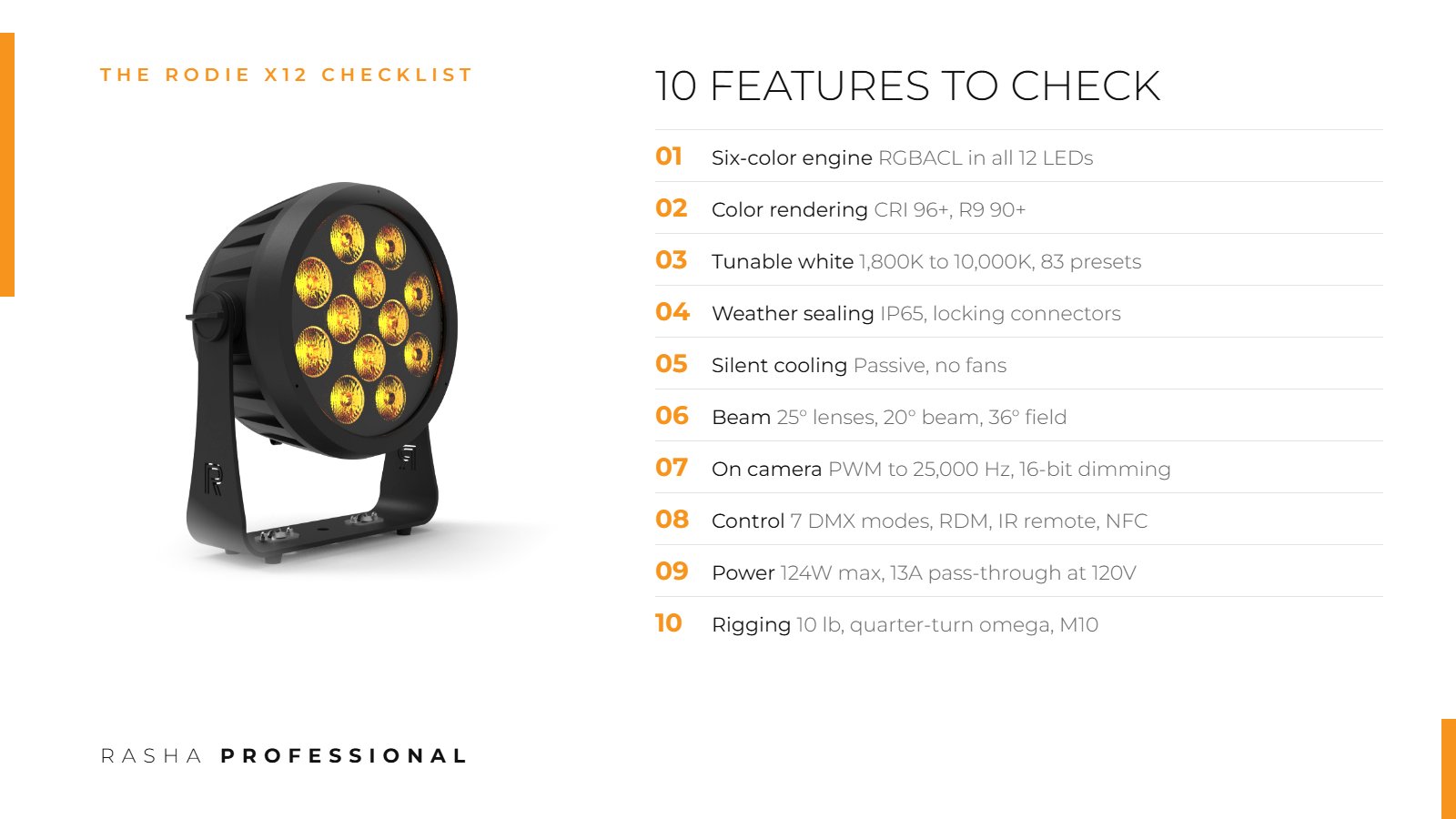
Feature | What to look for | Rodie X12 |
|---|---|---|
1. Color engine | Mixing colors beyond RGB | RGBACL, six colors in all 12 LEDs |
2. Color rendering | CRI 90+, strong R9 | CRI 96+, R9 90+, TLCI 90 ±6 |
3. Tunable white | Warm to cool range | 1,800K to 10,000K, 83 presets |
4. IP rating | IP65 for outdoor work | IP65 with locking IP65 connectors |
5. Cooling | Quiet operation | Passive cooling, no fans |
6. Beam | Wide enough to wash | 25° lenses, 20° beam, 36° field |
7. On camera | High PWM, 16-bit dimming | PWM up to 25,000 Hz, 16-bit in 20/25ch |
8. Control | DMX, RDM and simple options | 7 DMX modes, RDM, IR remote, NFC app, timer |
9. Power | Low draw, power linking | 124W (1.0A) max, 13A pass-through at 120V |
10. Rigging | Light, fast to hang | 10 lb, quarter-turn omega, M10 hole |
Who is the Rodie X12 for?
Anywhere you'd use a PAR, the Rodie X12 fits, with more color behind it.
Houses of worship that need quiet fixtures, good skin tones on the livestream and a white that matches the room. See our church stage lighting page.
Event and wedding companies doing uplighting and stage wash, indoors and out. See event lighting.
Theaters and schools that want wash, key and color from one fixture. Read our guide to LED wash lights for theater.
Rental companies that need one fixture to cover many kinds of jobs. Compare engines in six-color LED wash lights compared.
See it before you buy
The best test is your own room, your own console and your own color picker. Book a Rodie X12 demo, explore the Rodie X12 product page, or contact our team.
Call (951) 654-3585 or email sales@rashaprofessional.com. Dealers can learn about the Rasha reseller program.
Frequently asked questions
Quick answers about choosing an LED wash light and the Rodie X12.
Check ten things: the color engine, color rendering (CRI and R9), the tunable white range, the IP rating, the cooling method, the beam and field angle, PWM frequency and dimming for camera work, the control options, the power draw and pass-through, and the weight and rigging.
Look for CRI 90 or higher, with a strong R9 value for reds and skin tones. The Rodie X12 measures CRI 96+ and R9 90+ from 2,500K to 10,000K, with TLCI 90 ±6 for camera.
RGBACL stands for red, green, blue, amber, cyan and lime. In the Rodie X12, each of the twelve LEDs carries all six colors, which helps it reach pastels, teal and warm tones that RGB fixtures struggle with.
Use an IP65-rated fixture with sealed connectors. The Rodie X12 is IP65 with locking IP65 power, operates from -4°F to 113°F (-20°C to 45°C), and suits semi-permanent outdoor use such as festivals, seasonal stages and holiday building washes.
Yes. It uses passive cooling with no fans, so it makes no fan noise, which suits churches, theaters, studios and speaking events.
PWM is selectable from 800 Hz up to 25,000 Hz. For video and livestreams, set it to 12,000 or 25,000 Hz. The 20- and 25-channel DMX modes also give 16-bit dimming for smooth fades.
Seven: 4, 5, 6, 9, 13, 20 and 25 channels, with RDM over 5-pin DMX. It also includes an IR remote, works with an NFC app, and has 78 Lee filter presets and a built-in daily timer.
124W (1.0A) maximum at 120V and 12W at idle. Input is 100 to 240 VAC auto-ranging, and power pass-through is rated at 13A at 120V and 16A at 240V.
10 lb (4.6 kg). It ships with a quarter-turn omega bracket and has an M10 clamp hole in the yoke and a rear safety cable point.
Tyler Hayes
With over 15 years in the entertainment lighting scene, Tyler Hayes has helped shape unforgettable live experiences across stages, clubs, and festivals. He writes about how lighting transforms moments into lasting memories. His passion lies in inspiring others to see light not just as illumination, but as the heartbeat of every great event.
Related posts
Posted on 07/23/2026
Battery Powered Pinspot Bar: What Rental Companies Need to Know Before Adding One to Inventory
If you run a rental company, you already know most lighting fixtures are built for a showroom, not a truck. They look great on a demo table and fal
Posted on 07/15/2026
Church Lighting Upgrade Guide: How to Plan a Modern Worship Lighting System
I have stood on more church platforms at 11 pm on a Saturday than I can count, aiming a fixture at a pulpit while someone holds a ladder. Church li

Posted on 07/01/2026
How Do I Choose the Right Professional Stage Lighting Manufacturer for My Production Company?
A practical buying guide for production companies, rental houses, and lighting designers evaluating manufacturer partnerships — not just product sp
Posted on 05/14/2026
Why U.S. Production Companies Are Rethinking Their Stage Lighting Strategy in 2026
A Complete Guide to Choosing the Right Professional Stage Lighting Partner — and Why It Starts with Rasha Professional
What Is Profe

Posted on 04/23/2026
LED Video Wall & Smoke Fogging Machine Guide
An LED video wall and smoke fogging machine are essential components of modern stage lighting and event production. LED video wall panels provide h



