.png&w=1920&q=75)
Posted on 07/23/2026
Battery Powered Pinspot Bar: What Rental Companies Need to Know Before Adding One to Inventory
If you run a rental company, you already know most lighting fixtures are built for a showroom, not a truck. They look great on a demo table and fall apart after the tenth load-in. A battery-powered pinspot bar has to survive tear-down at 1 a.m., a bumpy ride in a box truck, and a crew member who is in a hurry. This guide walks through the Rasha Bullet Bar, feature by feature, from the point of view of the person who has to stock it, ship it, and get it back in one piece.
What Do Rental Companies Actually Look for in a Lighting Fixture?
Ask ten rental company owners what they want from a new fixture and you will hear the same list, in some order:
A product that holds up to constant use, at a price that still leaves room for margin
A supplier who ships on time, every time, because a late order means a lost gig
Something simple enough that a part-time crew member can set it up and tear it down without a manual
A compact footprint, since truck space and warehouse shelving are both limited
Road cases, truss, clamps, and cables available from the same source, not five different vendors
Real support and a warranty that means something when a fixture fails on a Friday night
Room to upsell, because a rental quote with only one line item leaves money on the table
None of this is new to anyone who has run a rental warehouse. What is harder to find is a manufacturer that builds around this list instead of around a spec sheet meant to impress a buyer who will never touch the product in the field. A fixture that looks good in a catalog photo but needs a screwdriver at every load-in is not solving a rental company's problem; it is adding to it. That is the gap this guide is meant to close.
Fair pricing matters here too, and it is worth being direct about it. A rental company is not looking for the cheapest fixture on the market, and it is not looking for the most expensive one either. It is looking for a price that matches what the product delivers over its working life, factoring in how many events it will run, how little it will need in repairs, and how much crew time it saves on every load-in. A fixture priced fairly is one where the total cost of owning it, not just the sticker price, works in the rental company's favor over two or three seasons.
That is the list we used to evaluate the Bullet Bar for this guide. Every feature below maps back to one of these points.
What Is the Bullet Bar, and Why Is It Called a Battery-Powered Pinspot Bar?
1. What does the Bullet Bar do?
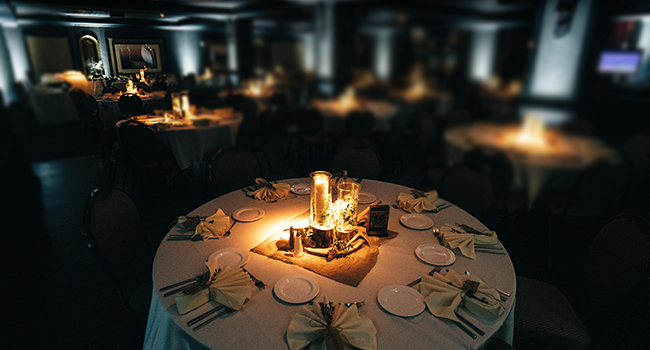
The Bullet Bar is a battery-powered pinspot bar with six individually aimed 2700K warm white LED heads on one compact base. Each head is its own mini pinspot, mounted on a flexible gooseneck, so a crew can point all six at a single sweetheart table or spread them across six separate centerpieces. It is built to highlight decor, florals, cake tables, and head tables at weddings, galas, and premium private events, the kind of work where a plain wash light does not cut it.
2. Why "pinspot bar" instead of just "pinspot"?
.png)
A single pinspot lights one thing. A pinspot bar puts six pinspots on one power run, one DMX address, and one battery, so a rental crew carries and sets up one unit instead of six separate lights, six separate stands, and six separate power drops. That is the entire point of the format, and it is why rental houses buy it by the bar, not by the head.
Quick Spec Snapshot
Bullet Bar at a glance
Spec | Detail |
|---|---|
Light source | 6 x warm white LED, 2700K, CRI 95, 50,000-hour rated life |
Beam control | Push/pull Fresnel focus, 3° to 15° field angle, per head |
Runtime | 7 to 10 hours on a full charge, charges while running |
Control | DMX (7 or 12 channel), 2.4 GHz wireless DMX, IR remote, manual, sound active |
Mounting | Tool-less quarter-turn omega bracket, fits standard clamps |
Connectors | Locking IP65 power in/through, 5-pin XLR DMX in/through |
Dimensions | 24.76 x 3.5 x 7.8 in (629 x 89 x 198 mm) |
Weight | 8.8 lbs (4.0 kg) |
Cooling | Passive, heat sinks (no fan noise) |
Operating temperature | 32°F to 122°F (0°C to 50°C) |
Warranty | 2 years on the fixture, 6 months on the battery |
Compliance | ETL, CE, RoHS, FCC |
Bullet Bar Features That Solve Real Rental Pain Points
Here is the part that matters most for a rental buyer. Every fixture spec sheet reads well. The question is whether the spec actually fixes something that costs your crew time or money. Below are the features, organized around the pain points rental companies deal with every week.
1. Is the housing tough enough for repeated rental use?
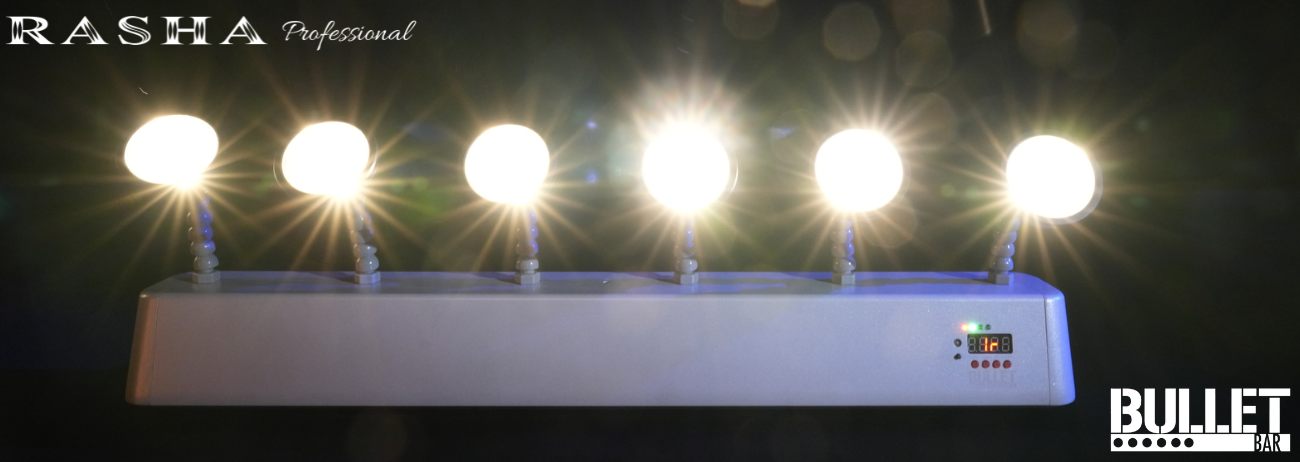
The body is anodized aluminum, the same finish used on truss and rigging hardware because it resists scratching, corrosion, and the general abuse of being loaded and unloaded hundreds of times a year. The goosenecks are thermal plastic, built to flex and hold position without snapping or sagging after repeated repositioning. This is not a fixture designed to look good once. It is designed to look and run the same after two hundred shows as it did on day one.
2. What is the LED life expectancy, and does that matter for a rental fleet?
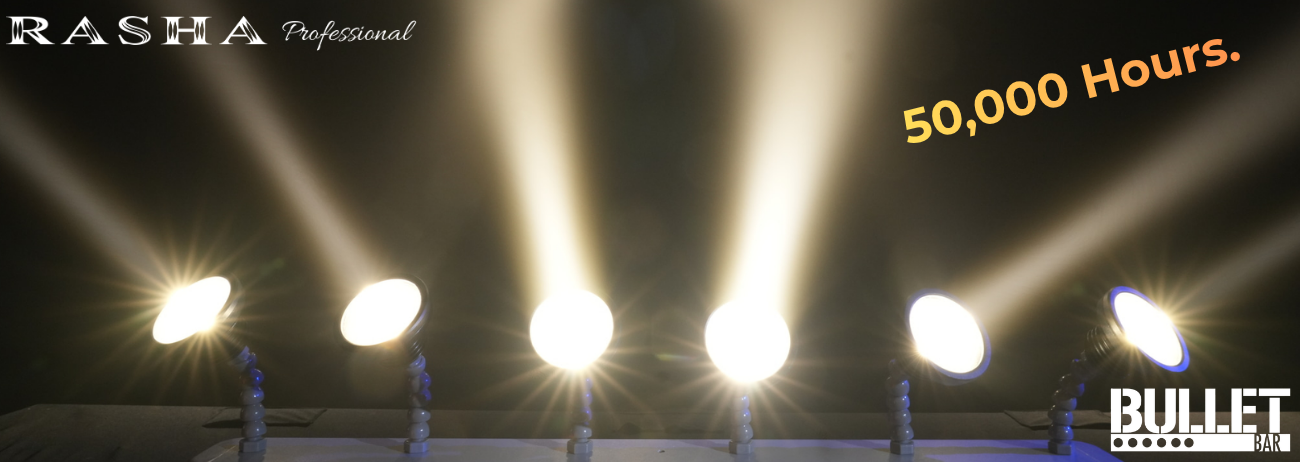
Each head runs a 10W warm white LED rated for 50,000 hours. Run it 10 hours a week and you are looking at close to a hundred years before the LED itself is the reason to retire the fixture. For a rental company, that means the LED is never the failure point. Whatever end-of-life a unit eventually has, it will not be the light source.
3. Does it carry a real warranty, or just a manufacturer's claim?
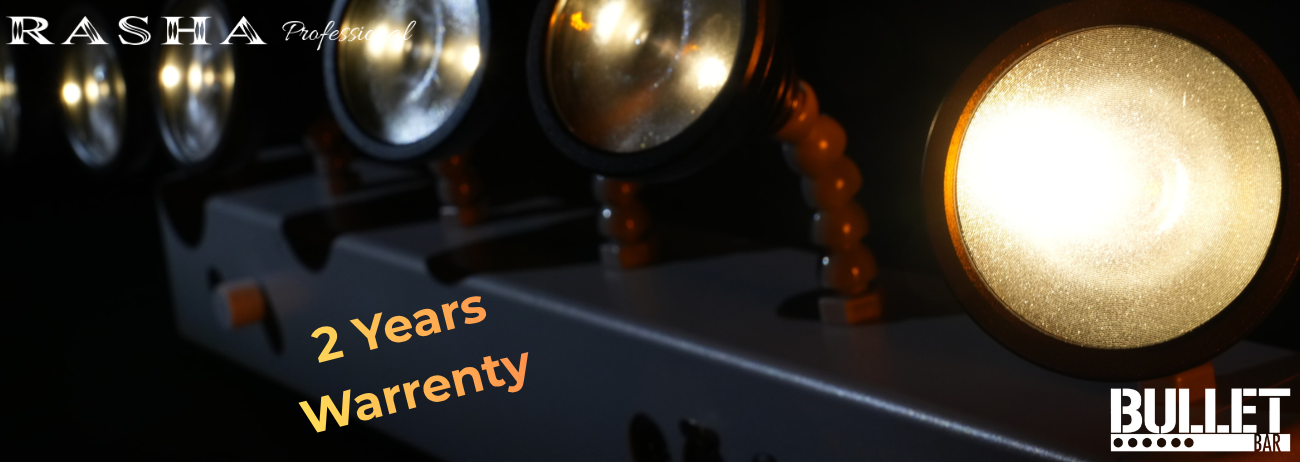
The Bullet Bar carries a 2-year limited warranty on the fixture and a 6-month limited warranty on the battery. That split matters. Batteries wear differently than aluminum housings and LEDs, so a separate, honest warranty term on the battery is a more accurate promise than a blanket claim covering everything the same way. Rasha Professional, a professional stage lights manufacturer, backs both terms directly, and support is available if a unit needs service.
4. How fast can a crew mount and unmount the Bullet Bar?
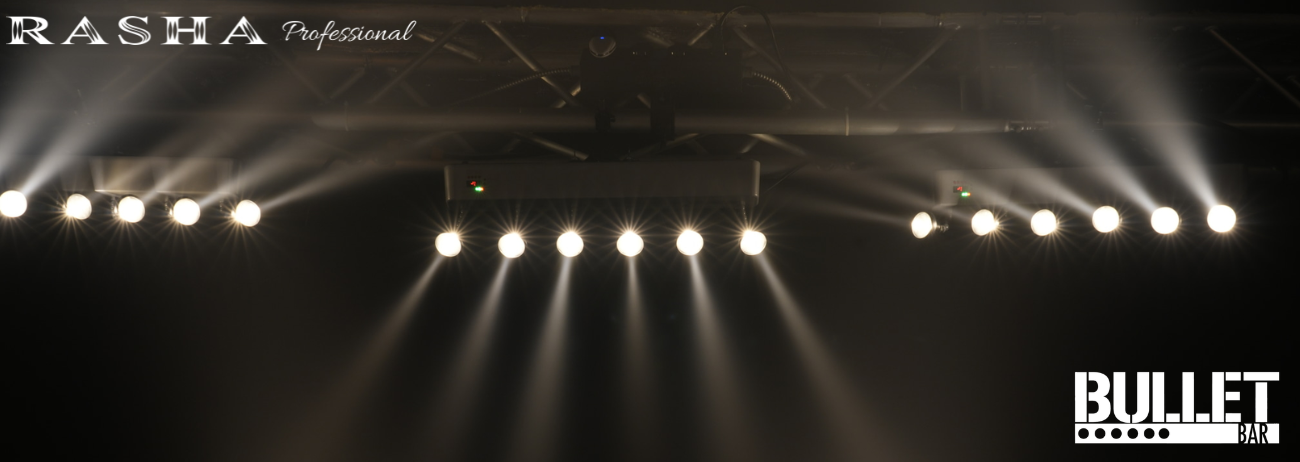
This is where the new generation made its biggest change. The old bracket used hex screws that had to be hand-tightened every single time a unit went in or out of the road case. The new Bullet Bar uses a tool-less quarter-turn omega bracket. A crew member locks it onto truss or pipe with a quarter turn, no Allen key, no loose hardware to lose in a road case at 11 p.m. For a rental company running back-to-back load-ins on a Saturday, that is real time saved across every unit in the fleet, not just one.
5. Can a less experienced crew member run this without training?
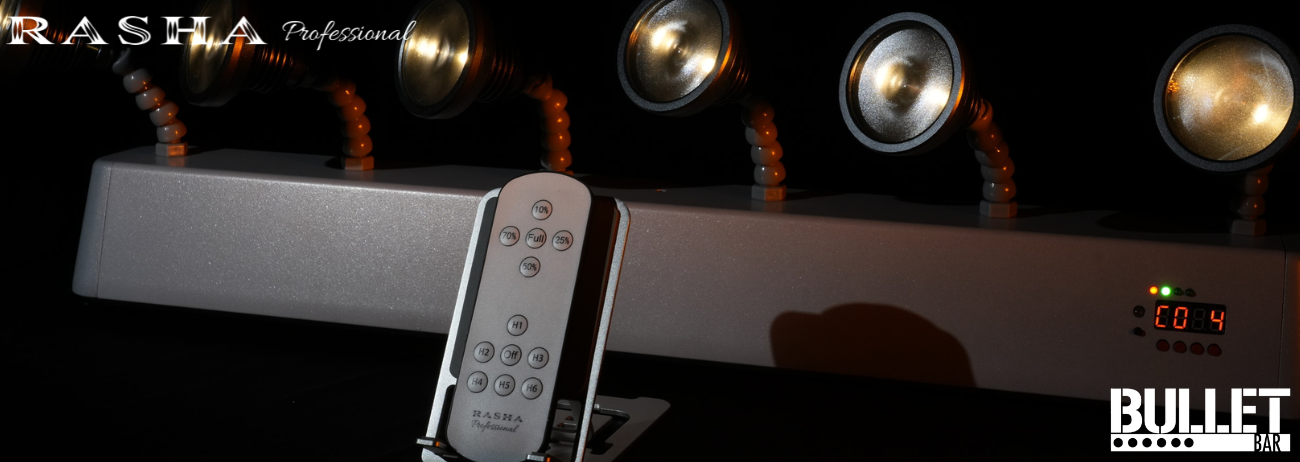
Yes. The IR remote lets an operator aim, dim, and control all six heads, or any single head, from the floor, without touching a lighting console. That means a rental company can send a junior crew member or even hand control to the venue's own event coordinator without a technical walkthrough. The menu is a simple 4-button interface, and the IR sensor is top-facing so it reads the remote from normal working distance.
6. What happens if a fixture is left plugged in overnight or between events?
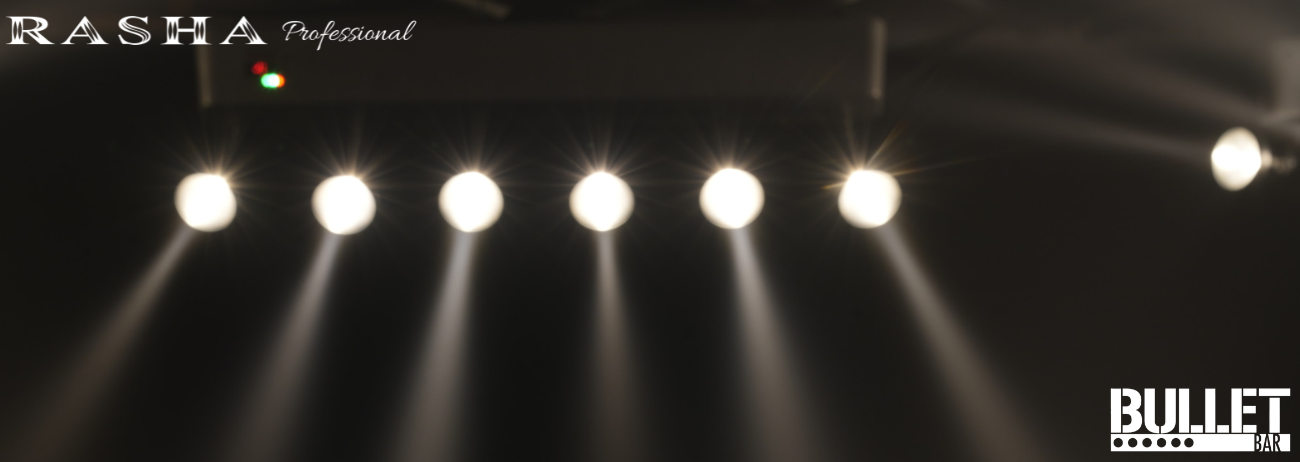
The internal battery has an automatic cut-off, so the fixture can stay plugged in safely without a crew member having to remember to unplug it. It also charges and runs at the same time, so a unit can sit connected to power backstage all night and still be at full charge, or running the whole event, without anyone monitoring it.
7. How much truck and shelf space does the Bullet Bar take up?
At 24.76 x 3.5 x 7.8 inches and 8.8 lbs, the Bullet Bar is built to stack. A 4-unit box measures 28 x 21 x 13 inches and weighs 51 lbs total, which is manageable for one person to carry. A 6-unit road case comes in at 28 x 17 x 34 inches, 105 lbs loaded and 59 lbs empty, sized to fit standard cargo van and box truck layouts without eating the whole load.
8.8 lbs - Per unit weight
6 - Heads per bar
2 yr - Fixture warranty
8. Does Rasha offer a matching road case, or does the rental company have to source one separately?
Rasha offers a purpose-built 6-unit road case (SKU RP-BBAR-6-CRC) sized exactly to the fixture. That matters for a rental business because a case built for the product protects the goosenecks and connectors during transport, and it means one purchase order covers the fixture and its case instead of a separate hunt for a case that happens to fit.
9. Does the beam actually look good on camera and in person?
Each head runs at CRI 95, which is a meaningfully higher color rendering score than most fixtures in this category. In plain terms, CRI measures how true colors look under a light source compared to natural daylight, and the U.S. Department of Energy's lighting research explains why that number matters for how skin tones, florals, and linens read under a fixture. At CRI 95, warm white reads true on camera and to the naked eye, which is the difference between a centerpiece that looks lit and one that looks correct.
10. Can one fixture handle both a tight pinspot look and a soft wash?
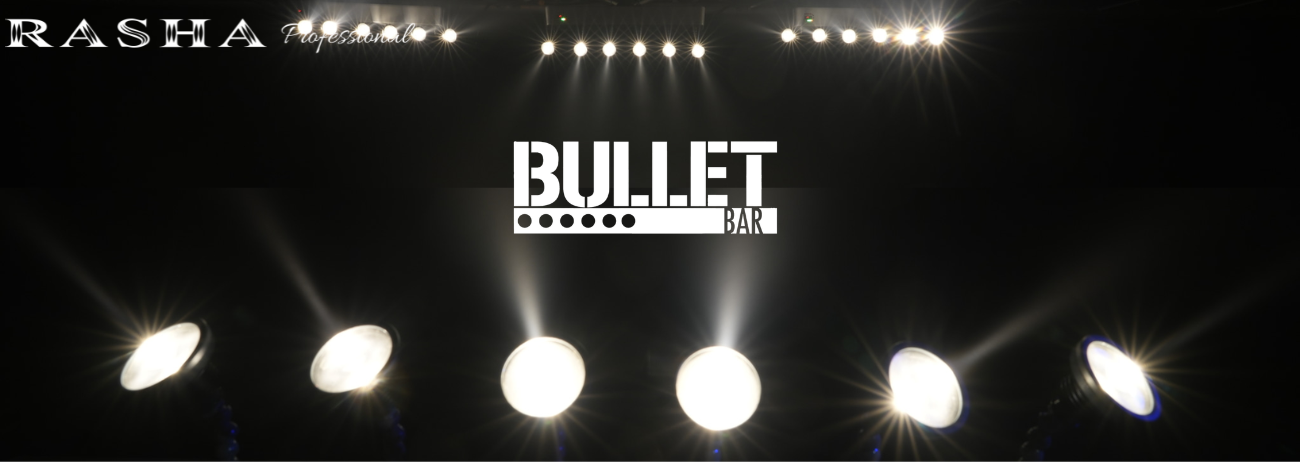
Yes. Each head has its own push/pull Fresnel lens. Push it in, and you get a tight beam with a defined edge, good for a long throw across a ballroom onto a single centerpiece. Pull it out and the beam blooms into a soft wash with no hot spot, better for closer, wider coverage. The field angle ranges from 3 to 15 degrees, adjusted by hand, per head, so a crew can mix tight and wide looks on the same bar depending on the room.
11. What control options does the Bullet Bar support?
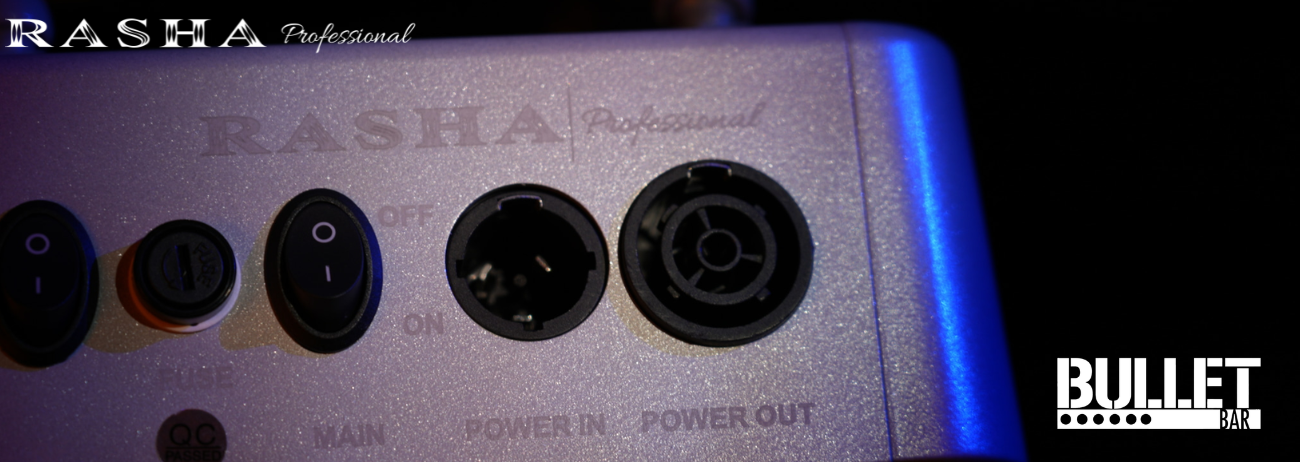
It runs on DMX (7-channel or 12-channel modes), 2.4 GHz wireless DMX, IR remote, manual, auto, and sound-active mode. That range matters because a rental company serves different clients with different setups: some events run a full DMX console, some just need the fixture to run its own auto or sound mode with nobody touching it all night. The Bullet Bar covers both without needing a different fixture for each job.
12. How does the wireless DMX and IR system actually work in the field?
Wireless DMX runs on the 2.4 GHz band, a widely used industry standard for untethered lighting control described by organizations like ESTA's Technical Standards Program, which develops the entertainment industry's DMX and wireless protocols. The IR remote works from 10 to 20 feet depending on the environment, and it can control each head individually (H1 through H6), dim in steps from off to full, or shut every head off at once with a single button. That level of per-head control from the floor is not common at this size and price point.
13.Will the new Bullet Bar work alongside the older units we already own?
Yes, and this is one of the most important answers for a rental company that already stocks the previous generation. The menu structure, DMX profiles, and operational logic are unchanged from the earlier Bullet Bar. New units drop into an existing rig, patch the same way, and run the same show file as older units, side by side. There is no retraining, no reprogramming, and no console repatch. The upgrade is in the hardware, the housing, the mounting, the connectors, and the optics, not in how the crew operates it.
14. Does the Bullet Bar run quiet enough for a wedding or a quiet indoor venue?
Yes. Cooling is fully passive, using heat sinks instead of a fan, so there is no motor noise competing with vows, toasts, or a first dance. That matters for the exact events this fixture is built for, where a fan hum right next to the head table would be noticeable and unwelcome. It also means one less moving part that can wear out or fail over years of use.
15.Can the Bullet Bar handle both a cold morning load-in and a hot outdoor tent?
The rated operating range is 32°F to 122°F (0°C to 50°C), which covers everything from an early load-in at an unheated venue to a mid-summer reception under a tent. A rental company does not have to keep a separate fixture in the fleet just for outdoor summer events or cold-weather setups.
16. Are the power and data connections rated for outdoor or high-traffic events?
The Bullet Bar uses locking IP65 power connectors, in and through, plus locking 5-pin XLR for DMX in and through. IP65 means the connector is dust-tight and protected against low-pressure water jets, a rating standard defined by the National Electrical Manufacturers Association. Locking connectors also mean a cable does not pull loose mid-show when a guest walks past a stand or a cable gets bumped during a busy load-in. That is a small detail on a spec sheet and a real problem avoided on a show floor.
17. How should a rental company weigh the cost of adding this fixture to the fleet?
Look past any single number on an invoice and count what the fixture actually costs to own over its life. A 2-year warranty on the fixture and a 50,000 hour LED rating both push repair and replacement costs down. A tool-less bracket cuts labor time on every single load-in and load-out, which adds up fast across a season with dozens of events. A compact footprint means it takes up less billable truck space next to bigger fixtures. None of that shows up on a sticker, but all of it shows up in a rental company's margin by the end of the year. The fair comparison is not this fixture against a cheaper one on cost alone, it is this fixture against a cheaper one once labor time, downtime, and replacement cost are added back in.
18. Can a rental company order road cases, mounting hardware, and cables from the same place?
Yes. Beyond the fixture itself (offered in silver, SKU RP-BBAR-SLV, and black, SKU RP-BBAR-BLK), each unit ships with a locking IP65 power cable and Edison adapter, a 5-pin DMX cable, a 2.4 GHz wireless DMX antenna, and an IR remote included with every two fixtures. The bracket's M12 hole pattern fits standard professional clamps already sitting in a rental company's truss inventory, so there is no need to special-order a proprietary clamp. That combination, fixture, case, cables, and standard hardware compatibility, is what turns a single-line order into a full package quote, which is exactly the kind of upsell opportunity a rental business wants on an invoice.
19. What does a full Bullet Bar package look like on a rental quote?
Most rental companies do not quote a client one fixture on its own. A typical Bullet Bar line item on a wedding or gala quote pairs the fixture with a length of truss to mount it on, a base plate or stand if the venue has no rigging point, a clamp for each bracket, a DMX cable run back to a controller if wireless is not used, and the road case for transport and storage between events. Because the omega bracket's M12 hole pattern matches standard clamps already common in the industry, a rental company does not need to stock a special clamp just for this fixture, which keeps that part of the quote simple. The result is a package quote with several line items instead of one, which is where the real margin on an event usually sits.
How Is the New Bullet Bar Different From the Old One?
Rental companies restocking an existing Bullet Bar inventory need to know exactly what changed and why. Here is the honest comparison.
Old Bullet Bar vs. current generation
Area | Previous generation | Current generation |
|---|---|---|
Body design | Industrial look, out of place at upscale events | Redesigned body that fits elegant, high-end event environments |
Mounting hardware | Hex screws, hand-tightened every load-in and load-out | Tool-less quarter-turn omega bracket, anodized aluminum, M12 holes for standard clamps |
Install market fit | Design and mounting limited it to event-only use | New body and bracket open it up for permanent and semi-permanent install work |
Power and data connectors | Non-locking connectors, standard DMX | Locking IP65 power in/through, locking 5-pin XLR DMX in/through |
LED and optics | 2700K, inconsistent output between units | 2700K with CRI 95, improved optics for a cleaner beam |
Menu and DMX profile | Original menu and DMX logic | Unchanged, so old and new units run together in the same rig |
Setup time comparison: hex-screw bracket vs. tool-less omega bracket (per unit, average field time)
The menu and DMX compatibility being untouched is a deliberate call, not an oversight. It protects the operational investment a rental company already made in the previous Bullet Bar. Everything that changed sits in the hardware: the housing, the bracket, the connectors, and the optics. The workflow a crew already knows stays exactly the same.
Why Do Rental Companies Work With Rasha Professional?
1Is Rasha Professional set up to support rental businesses specifically, not just individual buyers?
Rasha Professional is a U.S.-based manufacturer of professional stage lighting, LED video walls, atmospheric effects, and special effects equipment. The company works directly with production companies, rental houses, installers, venues, and event planners across the country, which means the people answering support calls understand what a rental fleet actually needs: fast turnaround, consistent stock, and documentation a crew can hand to a client.
2What kind of support and documentation comes with a Rasha purchase?
Every product ships with manuals and technical guides built for setup and troubleshooting in the field, not just a warranty card. Rasha also provides direct technical and customer support, so a rental company is not left guessing when a fixture behaves unexpectedly during a busy season.
3Can a rental company see the Bullet Bar in action before adding it to inventory?
Yes. Rasha offers both showroom demos and virtual demos, so a rental buyer can evaluate the fixture, the beam quality, the mounting hardware, and the control options firsthand before committing warehouse space and budget to it. Booking a demo is the most direct way to see whether the Bullet Bar fits a specific fleet and client base.
4Are there financing options for rental companies building out a fleet?
Rasha offers flexible payment plans for qualified buyers, which matters when a rental company is trying to add a full set of Bullet Bars, road cases, and accessories in one order without disrupting cash flow. Financing details are available here for businesses looking to spread that cost over time.
5Does Rasha work with reseller and volume rental accounts?
Yes. Authorized resellers get direct manufacturer backing, volume-based pricing on bulk orders, and streamlined warranty claims handled directly with Rasha instead of through a third party. For a rental company building out fleet inventory across multiple fixture types, that direct relationship keeps the ordering and support process simple as the account grows.
Putting It All Together: Does the Bullet Bar Belong in Your Fleet?
Go back to the list from the start of this guide. Durability, fair pricing, on-time delivery, simple setup, a compact footprint, matching accessories, real support, a real warranty, and room to upsell. The Bullet Bar was built by a manufacturer that treats those points as the actual product brief, not as marketing language added after the design was finished.
The build is aluminum and thermal plastic, not a shell that flexes under normal handling. The bracket needs no tools, which saves real time on every single load-in across a season. The footprint is small enough to stack efficiently in a truck or on a shelf. The road case, cables, and standard clamp compatibility mean a rental company is not chasing down accessories from three different vendors. The warranty is specific and honest about what covers the fixture versus the battery. And because the new generation runs the same menu and DMX logic as the old one, a rental company already holding Bullet Bar inventory can add new units without touching a single show file.
That is the version of "durable, simple, and compact" that actually holds up once a fixture leaves the showroom and goes to work. The best way to confirm it fits your specific fleet, your truck layout, and your client base is to see it running in person.
See the Bullet Bar Before You Stock It
Book a showroom or virtual demo and see the mounting, the beam control, and the wireless DMX setup firsthand. Explore financing if you are building out a full fleet order with road cases and accessories.
Frequently Asked Questions
Find answers to the most common questions about the Bullet Bar, including battery life, control options, mounting, compatibility, and warranty.
A battery powered pinspot bar lights small, specific areas, like centerpieces, cake tables, or head tables, with a focused beam that runs on internal battery power instead of a fixed power drop. Rental companies use it at weddings, galas, and private events where running cable to every table is not practical.
Up to 10 hours at full output, with a typical range of 7 to 10 hours depending on the mode and dimming level in use. The battery also supports simultaneous charge and use, so it can stay plugged in and running without interruption.
No. It can run entirely from its included IR remote, or in manual, auto, and sound-active modes, with no console required. DMX and wireless DMX are available for productions that do use a console.
Yes. The menu structure and DMX profiles are unchanged from the previous generation, so new and old units patch, program, and run together in the same show without reprogramming.
None. The tool-less quarter-turn omega bracket locks onto truss or pipe by hand, and the M12 hole pattern fits standard clamps already used in most rental inventories.
A 2-year limited warranty on the fixture and a 6-month limited warranty on the internal battery, backed directly by Rasha Professional.

Tyler Hayes
With over 15 years in the entertainment lighting scene, Tyler Hayes has helped shape unforgettable live experiences across stages, clubs, and festivals. He writes about how lighting transforms moments into lasting memories. His passion lies in inspiring others to see light not just as illumination, but as the heartbeat of every great event.



