Posted on 10/21/2026
Pin Spot Lighting Guide: What It Is, How Many You Need and How to Choose
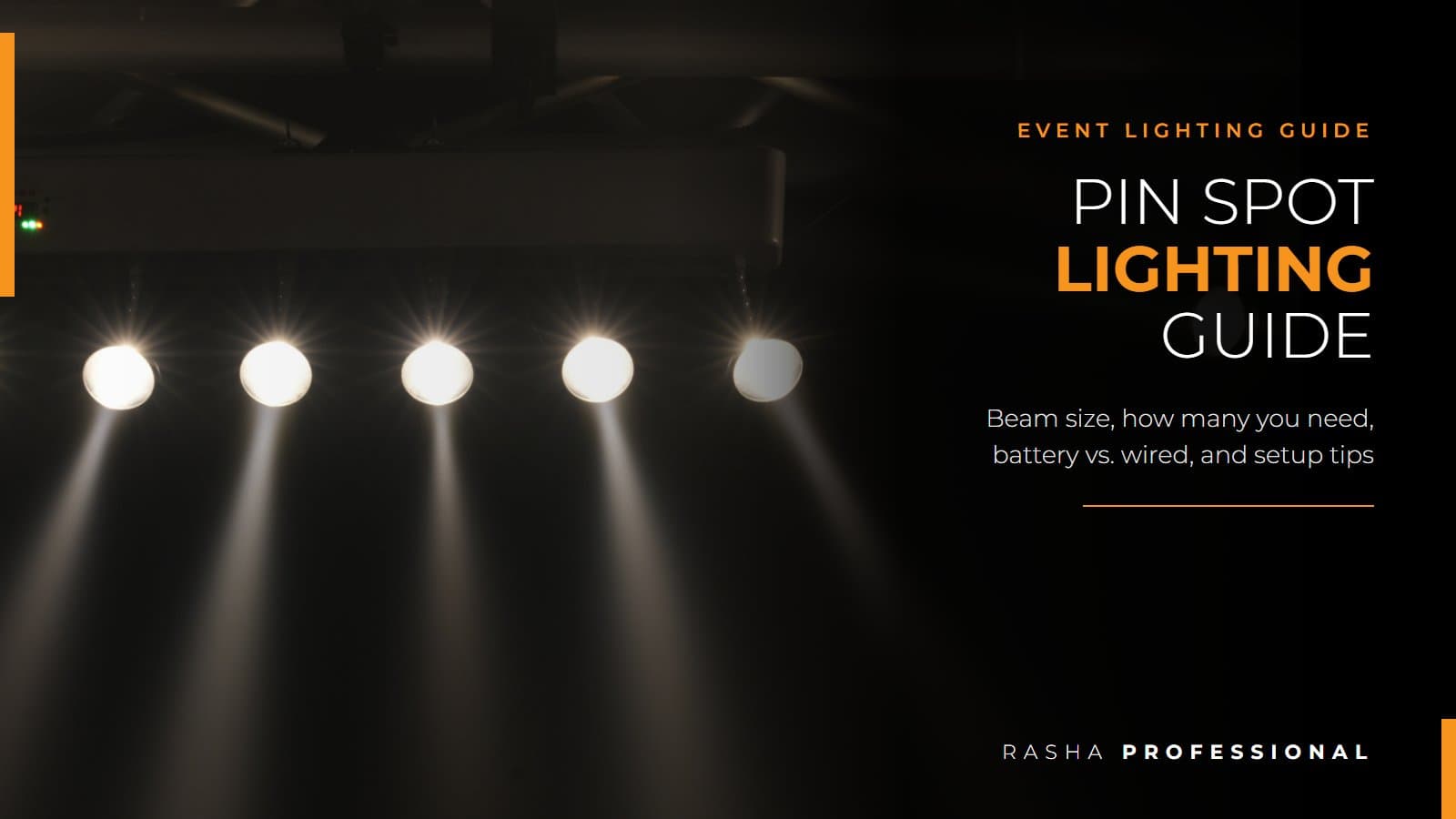
Quick answer: Pin spot lighting uses small fixtures with a very narrow beam, usually 3° to 15°, to light one object such as a centerpiece, a cake or a sign so it stands out in a dimmed room. Plan at least one pinspot per centerpiece, plus one for each feature like the cake, sweetheart table and escort cards. A 150-guest reception with 15 round tables usually needs 20 to 25 pinspots. Rasha Professional makes two battery-powered options: the Bullet Bar, a six-head pinspot bar, and the Bullet Pinspot, a single magnetic pinspot sold in pairs.
Walk into a ballroom with the house lights down and the centerpieces still sitting in the dark, and you can see what the room is missing. The florist spent days on the arrangements, and nobody can see them. Pin spot lighting fixes that. It is one of the most affordable ways to make a room look designed, and one of the easiest to get wrong if you guess at beam size, count or battery life.
This guide answers the questions we hear most from event crews, venues and planners: what a pinspot is, how big the beam will be from your truss, how many you need, battery vs. wired, and how to set them up fast. Along the way, we show how the Bullet Bar and Bullet Pinspot handle each one.
Key takeaways
Pinspots only work when the room is dim. Plan them together with the house lights and uplighting.
Count targets, not guests. One pinspot per centerpiece, two for tall arrangements, plus one per feature and a few spares.
Distance sets the beam size. At 15 feet, a 3° beam is about 9 inches across and a 15° beam is about 4 feet. Both Rasha pinspots zoom across that full range.
Plan battery life for the whole day. The Bullet Bar runs 7 to 10 hours at full output and can charge while it runs. The Bullet Pinspot runs up to 20 hours.
Warm white with high CRI looks best on decor. The Bullet Bar is 2,700K at CRI 95 and the Bullet Pinspot is 2,800K, close to candlelight.
What is a pin spot light?
A pin spot light, or pinspot, is a compact light fixture that throws a tight, narrow beam onto one object so it stands out from the rest of the room. The name comes from the classic PAR 36 "pin spot," a small can with a narrow lamp that event crews hung above tables for decades. Today most pinspots are LED, many run on a built-in rechargeable battery, and most have a zoom so you can make the beam tighter or wider.
Pinspots are used to light:
Table centerpieces and florals
The wedding cake or dessert table
The sweetheart or head table
Escort card displays, signs and guest books
Products, awards and sponsor displays at corporate events
Bars, ice sculptures and food stations
Pinspot vs. spotlight vs. uplight: what's the difference?
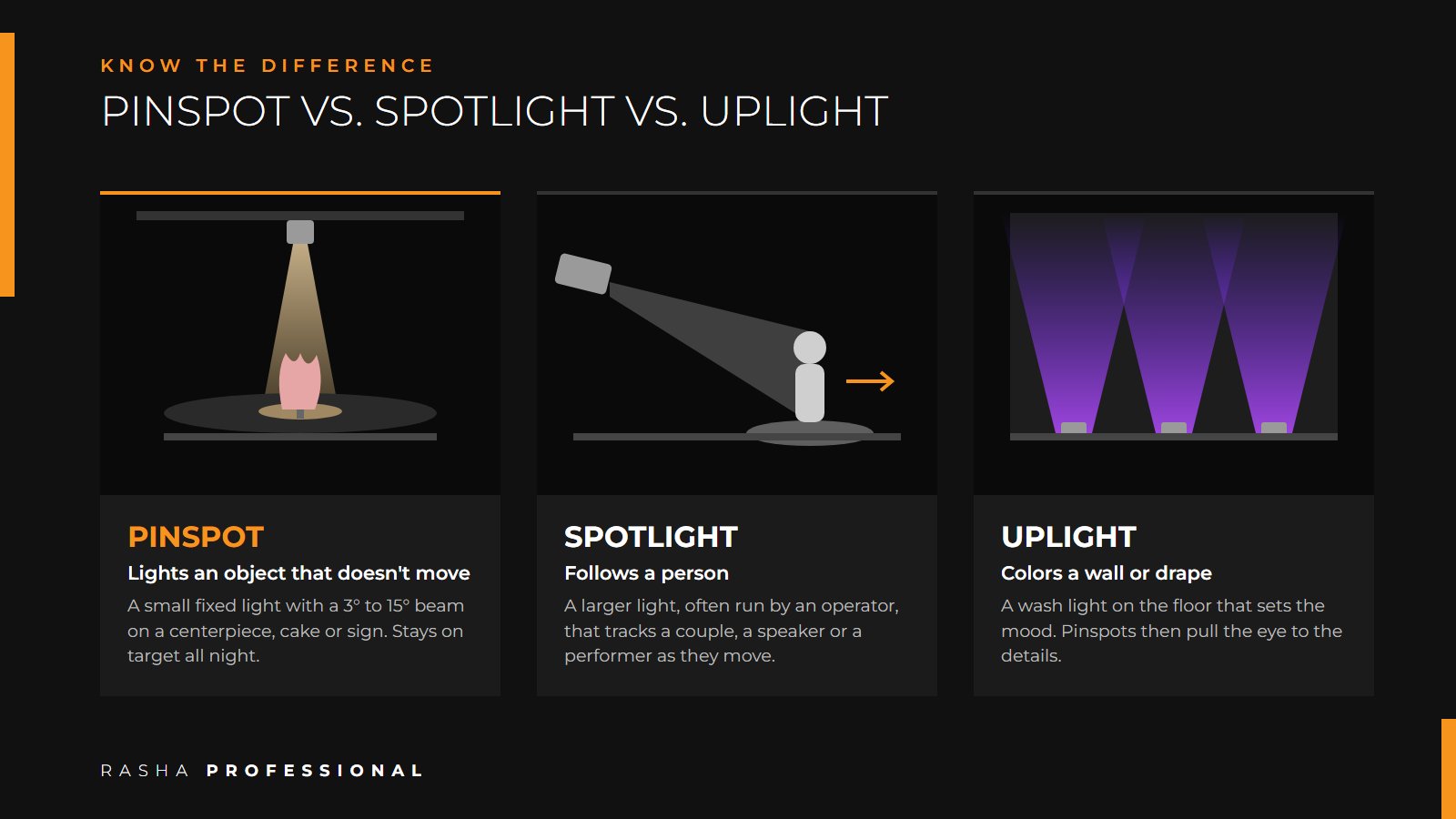
Pinspot: a small, fixed light aimed at an object that does not move, like a centerpiece. It stays on that target all night.
Spotlight (followspot): a larger light, often run by an operator, that follows a person, like a couple on the dance floor or a speaker walking the stage.
Uplight: a wash light set on the floor that colors a wall, column or drape. It sets the mood of the room.
Most good rooms use all three in layers. Uplighting sets the color, pinspots pull the eye to the details, and a spot or wash covers the people. Skipping pinspots because there are candles on the tables is a common mistake. Once the room goes dark, candles light the tablecloth, not the flowers above them.
How big is a pinspot beam?
A pinspot's beam size depends on two numbers: the beam angle and the distance from the light to the target. The farther away the light, the bigger the circle. That is why a pinspot that looks right on a demo table can be far too wide hanging 20 feet up in a hotel ballroom, and why a zoom matters.
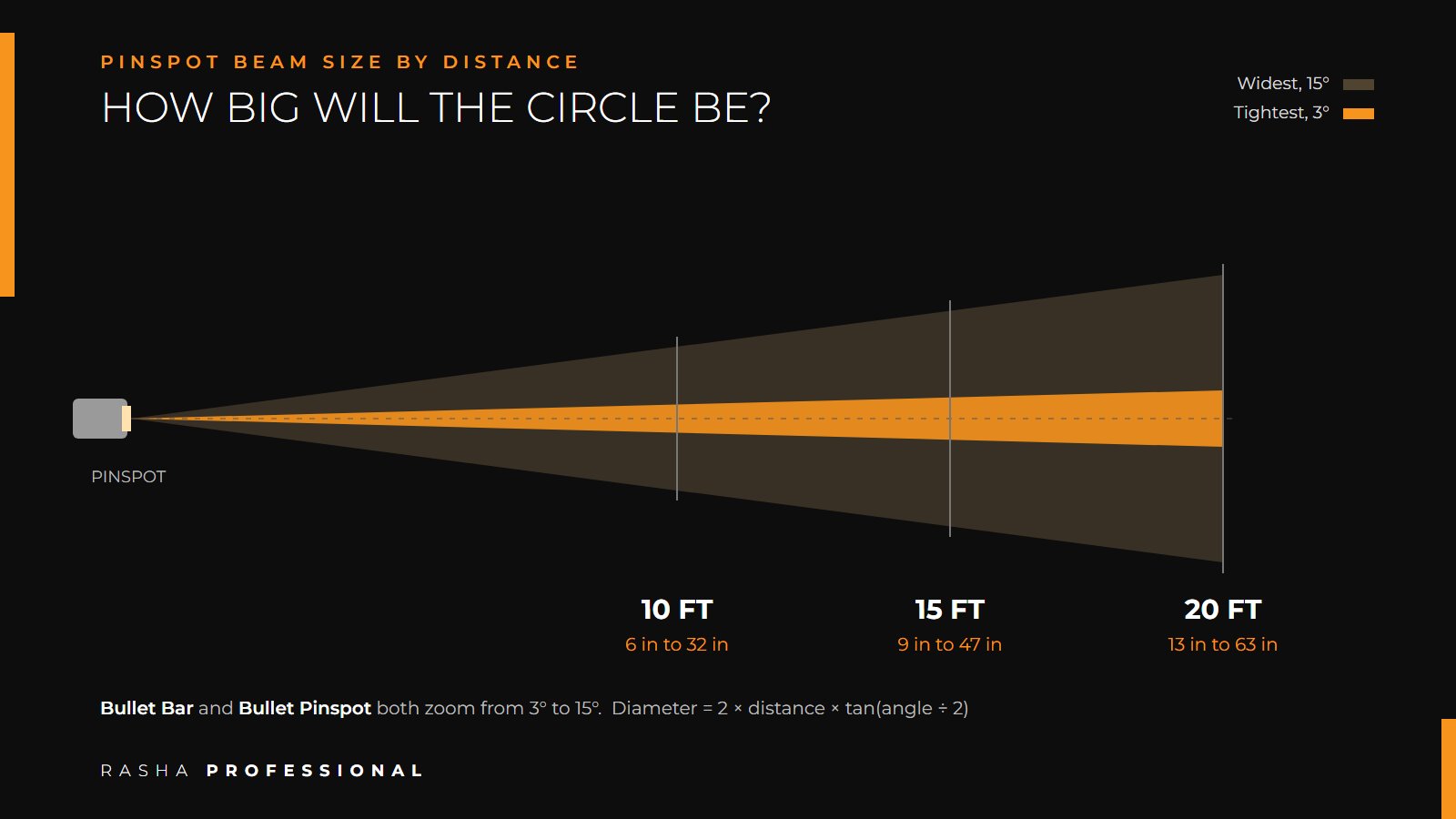
Here is the approximate diameter of the light circle for a pinspot with a 3° to 15° zoom, the range on both the Bullet Bar and the Bullet Pinspot:
Distance from light to target | At 3° (tightest) | At 15° (widest) |
|---|---|---|
10 feet | About 6 inches | About 32 inches |
15 feet | About 9 inches | About 47 inches |
20 feet | About 13 inches | About 63 inches |
Formula: circle diameter = 2 x distance x tan(angle ÷ 2). Measure on the diagonal: a light 18 feet up and 6 feet off to the side is about 19 feet from the target. Real edges are soft, so treat these as starting points.
What size circle do you want? For most round-table centerpieces, aim for a circle a little wider than the arrangement and smaller than the table. Light on the plates is fine. Light on guests' faces is not, because it puts glare in their eyes. A low centerpiece usually looks best in a circle of about 18 to 30 inches. A tall arrangement often needs a wider beam, or two pinspots from opposite sides, so the top and bottom both get light.
How the Rasha pinspots shape the beam: Each of the Bullet Bar's six heads has its own Fresnel lens. Push the lens in for a tight beam with a soft, defined edge for long throws, or pull it out for a soft wash with no hot spot for closer, wider coverage. The Bullet Pinspot has a manual 3° to 15° zoom with a soft-edge beam, so it blends into a white tablecloth instead of leaving a hard stage-style circle.
How many pinspots do you need per table?
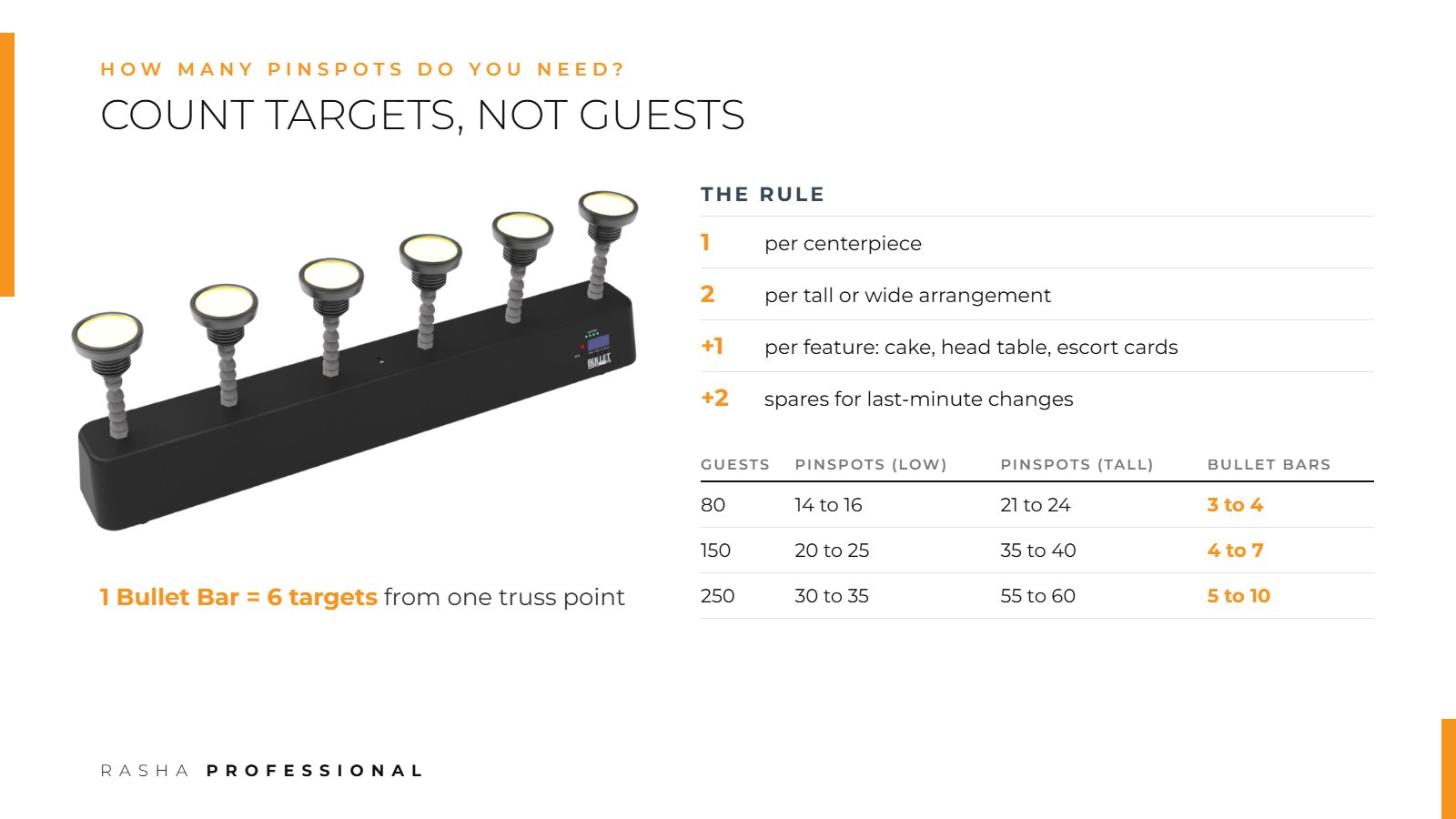
You need one pinspot per centerpiece, or two if the arrangement is tall or the table is long. Then add one for every feature you want guests to notice and two or three spares. Count targets, not guests:
Centerpieces: one pinspot per table. Use two for tall arrangements, large tables or long kings' tables.
Features: one each for the cake, sweetheart or head table, escort cards, signs and any display. Add a second for anything wider than about 4 feet.
Spares: add two or three. Floor plans change, and a planner will always find one more thing to light.
Event size | Typical tables | Pinspots (low centerpieces) | Pinspots (tall centerpieces) | Bullet Bars (6 heads each) |
|---|---|---|---|---|
80 guests | 8 rounds of 10 | 14 to 16 | 21 to 24 | 3 to 4 |
150 guests | 15 rounds of 10 | 20 to 25 | 35 to 40 | 4 to 7 |
250 guests | 25 rounds of 10 | 30 to 35 | 55 to 60 | 5 to 10 |
Counts include about five features and a few spares. Your layout may differ.
Single pinspots or a pinspot bar?
Use single pinspots when targets are spread out or hard to reach, and a pinspot bar when several targets sit under one truss or pipe.
The Bullet Pinspot goes almost anywhere. Its magnetic base sticks to truss, a steel beam or a metal stand, and its flexible neck lets you aim it in seconds. It is a good fit for a cake table, a sign, a shelf display or a centerpiece with no overhead rigging near it.
The Bullet Bar puts six pinspots on one 25-inch fixture. Each head sits on its own flexible gooseneck, so one bar on overhead truss can light six tables, or a mix of tables and decor, from one mount point. For the 150-guest room above, four Bullet Bars cover 24 targets with four mounts, four charges and four fixtures to load, instead of 24 of each.
Are battery-powered pinspots better than wired?
For most events, yes. Battery pinspots need no power runs, so they set up faster, go where cable can't and leave the room clean. Wired pinspots still make sense in permanent installs where power is already in place. The old way was a wired PAR 36 over every table, each needing its own power run. In a hotel with a drop ceiling or a strict house rigging policy, that meant hours of labor, or a flat no.
Battery-powered pinspots | Wired pinspots | |
|---|---|---|
Setup time | Fast. Mount, aim, turn on. | Slow. Every light needs a power run. |
Where they can go | Almost anywhere: truss, beams, decor, stands | Only where you can run cable |
Look in the room | Clean, no cables across ceilings or floors | Cables to hide and tape down |
Runtime | Limited by the battery, so plan charging | Runs as long as there is power |
Best for | Weddings, galas, pop-ups, rooms that change every weekend | Permanent installs with power in place |
You don't always have to pick one. The Bullet Bar runs on its internal lithium-ion battery or on power, and it charges while it runs. It has locking IP65 power in and through, so you can link several bars on one circuit. An automatic cut-off means it can stay plugged in safely. A venue that wants pinspots rigged over the main floor year-round can leave it plugged in, and a rental crew can pull the same model off a truck and run it on battery.
How long do battery pinspots last?
Most battery pinspots run 7 to 20 hours on a charge, depending on the model and brightness. The Bullet Bar runs 7 to 10 hours at full output and recharges in about 4 hours. The Bullet Pinspot runs up to 20 hours. The real day starts earlier than the event: crews often focus pinspots three or four hours before guests arrive, and the reception can run five or six hours after that. Habits that help:
Charge the night before. Keep the Bullet Bar plugged in through load-in and focus, since it can run and charge at the same time.
Focus, then dim or turn them off until the room flips. That saves battery for the event.
Run below full. In a dark room, pinspots rarely need 100%. The Bullet Bar's IR remote steps each head to 10, 25, 50 or 70%, which also stretches runtime.
Charge in the case. The 20-in-1 Bullet Pinspot Charging Case holds 20 Bullet Pinspots and charges them while they are stored, with power in and power out on the case. A back-to-back weekend doesn't mean 20 chargers on a folding table.
What should you look for in an LED pinspot?
Check seven things: zoom range, color temperature, color rendering (CRI), beam edge, mounting, control and noise. Here is what each means and how the Rasha pinspots handle it.
1. Zoom range
A fixed beam only works at one distance. A zoom lets the same light work from a low ceiling or high truss. Rasha: both the Bullet Bar and Bullet Pinspot zoom from 3° to 15°.
2. Warm white color temperature
Most decor looks best around 2,700K to 3,000K, close to candlelight. Cool white makes flowers look flat and gray next to candles. Rasha: the Bullet Bar is 2,700K and the Bullet Pinspot is 2,800K.
3. Color rendering (CRI)
CRI, the color rendering index, tells you how true colors look under the light on a scale up to 100. Look for 90 or higher so blush roses look blush and not beige, on the eye and on camera. Rasha: the Bullet Bar is rated CRI 95 (±2) across all six heads.
4. Soft beam edge
A hard-edged circle on a white tablecloth looks like a stage effect. A soft edge blends into the table. Rasha: the Bullet Pinspot has a soft-edge beam, and the Bullet Bar's Fresnel lenses give a soft, defined edge when tight and a soft wash with no hot spot when wide.
5. Mounting
Mounting time gets multiplied by every fixture in the room. Rasha: the Bullet Bar uses a tool-less quarter-turn omega bracket for truss or pipe, sits free-standing on four rubber feet, installs in any orientation and has a safety cable point. It weighs 8.8 lb (4.0 kg). The Bullet Pinspot uses a magnetic base and flexible neck, so there are no clamps or tools.
6. Control
An IR remote lets you dim and adjust from the floor without a ladder. Wireless DMX lets you tie pinspots into the rest of the show. Rasha: the Bullet Bar's IR remote selects each head (H1 to H6) and dims it on its own, from 10 to 20 feet away. It also runs wired DMX (7 or 12 channels) and 2.4 GHz wireless DMX, so a console can recall looks or change which tables are lit during the event. The Bullet Pinspot comes with an IR remote for brightness and group control.
7. Quiet operation
Pinspots sit right above guests. A fan you can hear during vows or speeches is a problem. Rasha: the Bullet Bar uses passive cooling with heat sinks and no fan.
How do you set up pinspots? (6 steps)
Lock the floor plan first. Moving one table after focus means re-aiming at least one light. Ask the planner to confirm the layout before you hang.
Hang and rough-aim. Mount bars on truss or pipe and place single pinspots on metal surfaces near their targets. Point each head at its target.
Dim the room to show level. A pinspot that looks right with the house lights on can look weak once the room goes dark, or too hot. Set levels in the real room.
Set the beam size. Zoom or slide the lens until the circle covers the arrangement and stays off guests' faces. Aim from a slight angle when you can: straight down lights only the top of the flowers.
Check from a guest's seat and with a phone camera. If you can see lens glare, re-aim or tighten the beam. If the centerpiece looks blown out in a photo, bring the level down.
Label your heads. On a Bullet Bar, note which head (H1 to H6) hits which table. When the planner asks to bring up table 12, you'll know which head to select on the remote.
Bullet Bar vs. Bullet Pinspot: which Rasha pinspot fits your job?
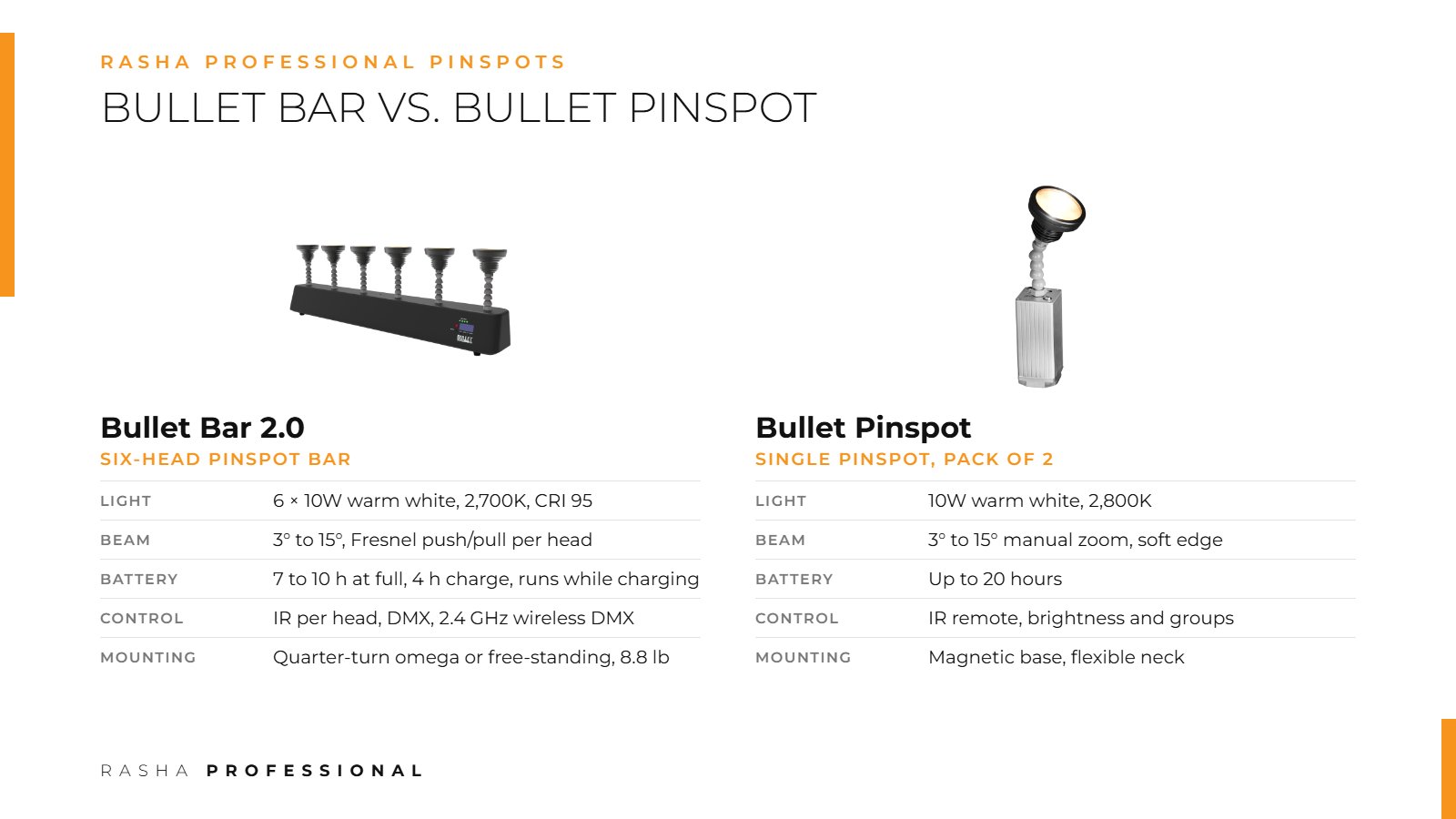
Pick the Bullet Bar when many targets sit under one truss or pipe and you want DMX control. Pick the Bullet Pinspot when targets are spread out, there is no rigging nearby, or you want the longest runtime. Many crews carry both.
Format | Six-head pinspot bar | Single pinspot, sold in pairs |
Light source | 6 x 10W warm white LED | 10W warm white LED |
Color | 2,700K, CRI 95 (±2) | 2,800K |
Beam | 3° to 15°, Fresnel push/pull focus on each head | 3° to 15° manual zoom, soft edge |
Battery | 7 to 10 hours at full output, 4-hour charge, runs while charging | Up to 20 hours |
Power | Locking IP65 power in and through | 9V DC charger for each pinspot |
Control | IR per-head select and dim, DMX (7 or 12 ch), 2.4 GHz wireless DMX | IR remote for brightness and groups |
Mounting | Quarter-turn omega bracket or free-standing, any orientation | Magnetic base, flexible neck |
Weight | 8.8 lb (4.0 kg) | Compact and lightweight |
Cooling | Passive, no fan | Not listed |
Warranty | 2-year fixture, 6-month battery | Not listed |
Best for | Lighting several tables from one truss point | Tucking a light anywhere, one target at a time |
Both are indoor fixtures. For the rest of the room, see the full range of professional battery-powered LED lights, including uplights.
Get your pinspot count
Send us your floor plan and our team will help you work out how many pinspots you need, where to mount them and whether the Bullet Bar, the Bullet Pinspot or a mix fits the room. Contact our team, book a demo, or browse all LED pinspot lights.
Call (951) 654-3585 or email sales@rashaprofessional.com. Dealers can learn about the Rasha reseller program.
Frequently asked questions
Quick answers about pin spot lighting, the Bullet Bar and the Bullet Pinspot.
A pin spot light, or pinspot, is a small fixture with a very narrow beam, usually 3 to 15 degrees, used to light a single object like a centerpiece, cake or sign so it stands out in a dimmed room.
Plan one pinspot per centerpiece, two for tall arrangements, plus one for each feature such as the cake, sweetheart table and escort cards, and a few spares. A 150-guest reception with 15 round tables usually needs 20 to 25 pinspots, or 35 to 40 with tall centerpieces. That is about four to seven six-head Bullet Bars.
It depends on the beam angle and distance. A 3 to 15 degree pinspot 15 feet from the target makes a circle about 9 inches wide at 3 degrees and about 47 inches wide at 15 degrees. The Bullet Bar and Bullet Pinspot both zoom from 3 to 15 degrees.
A pinspot is a small fixed light aimed at an object that does not move, like a centerpiece. A spotlight or followspot is a larger light, often run by an operator, that follows a person.
For most events, yes. Battery pinspots need no power runs, so they set up faster and can go where cable can't. Wired pinspots suit permanent installs with power in place. The Rasha Bullet Bar can run on battery or on power and charges while it runs.
Most run 7 to 20 hours depending on model and brightness. The Rasha Bullet Bar runs 7 to 10 hours at full output and charges in about 4 hours. The Bullet Pinspot runs up to 20 hours.
Warm white, around 2,700K to 3,000K, works best for most decor and blends with candlelight. Look for CRI 90 or higher so flowers and linens show their true color. The Bullet Bar is 2,700K at CRI 95 and the Bullet Pinspot is 2,800K.
A pinspot bar holds several pinspot heads on one fixture so one mount point can light several targets. The Rasha Bullet Bar has six heads on flexible goosenecks, each aimed, focused and dimmed on its own, with a built-in battery and DMX or wireless DMX control.
Mount it overhead on truss, pipe or a metal beam and aim it at the target from a slight angle rather than straight down. The Bullet Bar uses a tool-less quarter-turn omega bracket or sits free-standing. The Bullet Pinspot uses a magnetic base and flexible neck.

Tyler Hayes
With over 15 years in the entertainment lighting scene, Tyler Hayes has helped shape unforgettable live experiences across stages, clubs, and festivals. He writes about how lighting transforms moments into lasting memories. His passion lies in inspiring others to see light not just as illumination, but as the heartbeat of every great event.



