Posted on 11/23/2026
Uplighting a Reception Hall: How Many Fixtures You Actually Need
Quick answer: Plan one uplight for every 8 to 10 feet of usable wall, then add 3 to 6 fixtures for features like the head table and cake, plus 2 spares. For most reception halls of 100 to 400 guests, that comes to about 18 to 40 uplights. Count the wall, not the guests. A long, narrow room needs more lights than a square room with the same guest count.
Key points
Start with the wall: measure the room, then subtract doors, the stage, the bar and anything you won't light.
Pick a spacing: 6 to 8 feet for a solid wall of color, 8 to 10 feet for the classic look, 12 to 15 feet for soft accents.
Add the features: head table, cake, entrance and columns each get their own light.
Bring 2 spares: one for a fixture that gets knocked over or bumped, one for a spot you find on the day.
Check the battery: a wedding day often runs 8 hours or more from first look to last dance.
How many uplights do you need for a wedding?
Use this simple formula:
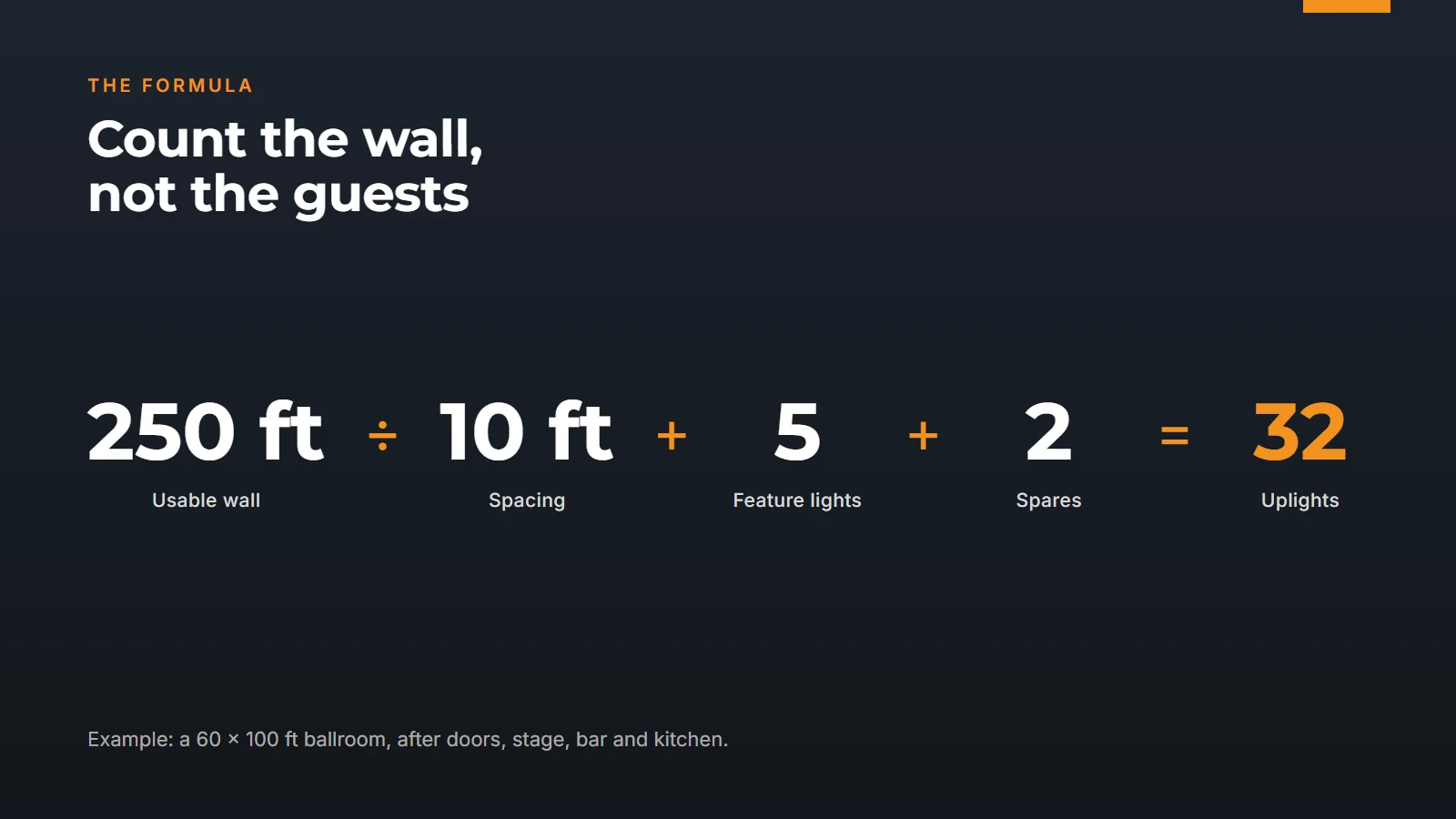
Usable wall length ÷ spacing + feature lights + 2 spares = uplights to bring
Measure the walls. Add up the length of every wall. A 60 by 100 foot ballroom has 320 feet of wall.
Take out what you won't light. Subtract doors, fire exits, the stage or DJ wall, the bar, kitchen doors and large windows. In most rooms that is 20 to 30 percent of the wall.
Divide by your spacing. 250 feet of usable wall at 10 feet apart is 25 uplights.
Add feature lights. Two behind the head table, one on the cake, two at the entrance: 5 more.
Add 2 spares. That is 32 fixtures on the truck for this room.
Quick count by room size
If you only know the room size, start here. Usable wall is estimated at 80 percent of the total wall. "Fits" is a rough guest count for a seated dinner with a dance floor.
Room size | Fits (rough) | Usable wall | Every 10 ft | Every 8 ft |
|---|---|---|---|---|
30 x 50 ft | Up to 100 | 130 ft | 13 | 16 |
40 x 60 ft | About 160 | 160 ft | 16 | 20 |
50 x 80 ft | About 260 | 210 ft | 21 | 26 |
60 x 100 ft | About 400 | 255 ft | 26 | 32 |
These are wall lights only. Add your feature lights and 2 spares on top.
Why not count by guests?
A common rule is one uplight for every 6 to 8 guests. It works for a mid-size room, but it breaks down at both ends. Guest count grows with the floor area. Wall length grows much more slowly. Double the size of a square room and you fit about four times the guests, but you only have twice the wall.
So the guest rule tends to give you too many lights in a big ballroom and too few in a long, narrow room or a barn. In the table above, a 400-guest room needs about 26 to 32 wall lights. The guest rule would say 50 to 67. Use guest count as a sanity check, and use the wall to plan.
How far apart should uplights be?
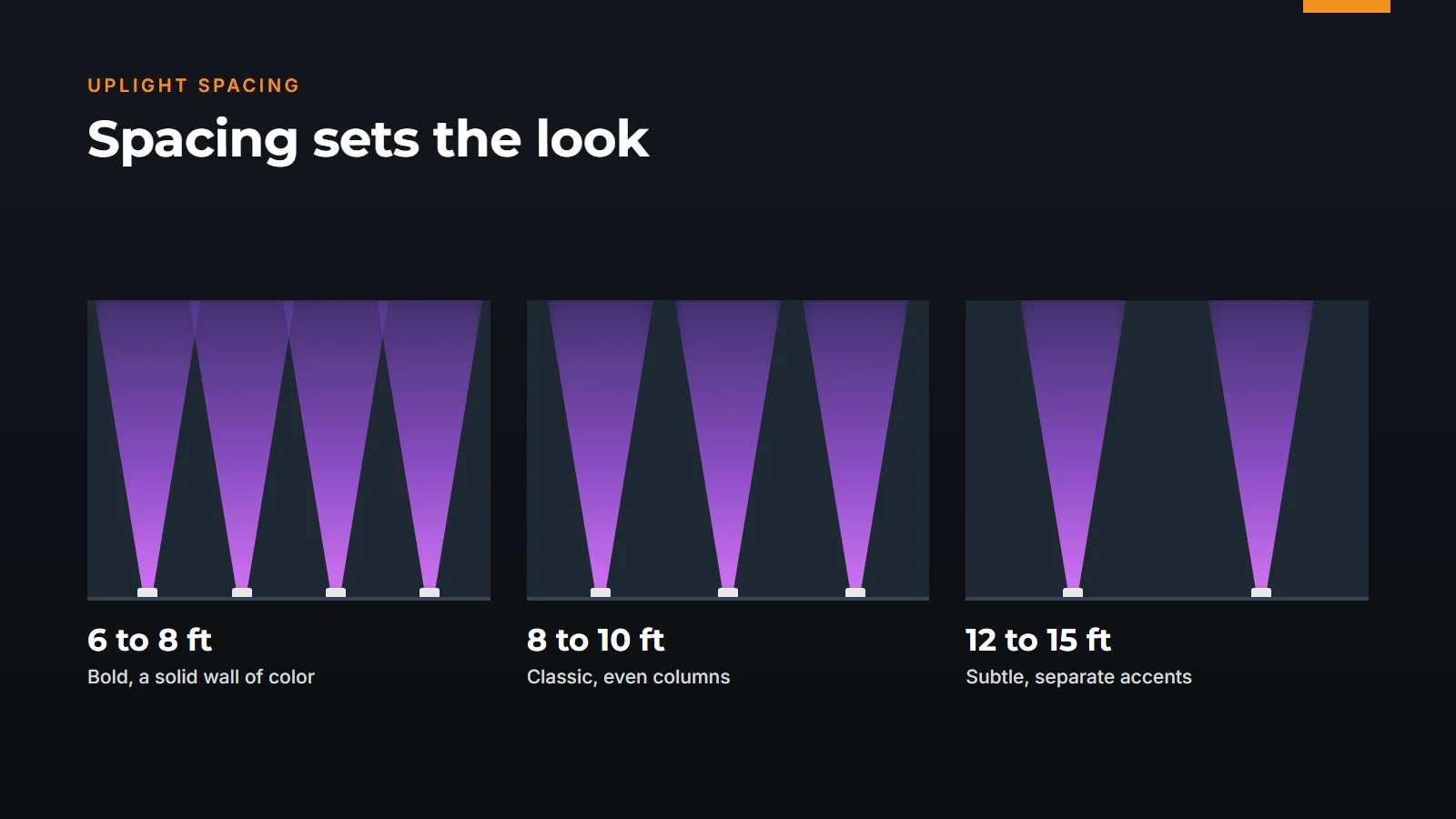
Spacing sets the look of the room. There is no single right answer, only the look the couple wants:
Spacing | The look | Good for |
|---|---|---|
6 to 8 ft | Columns blend into a solid wall of color | Bold color, dance-floor walls, low ceilings |
8 to 10 ft | Even columns with soft gaps between them | Most ballrooms and banquet halls |
12 to 15 ft | Separate columns of light as accents | Rooms with strong architecture, or when you have fewer fixtures |
Wall height matters too. A 25° beam set close to the wall is only about 4 to 5 feet wide at the top of a 10-foot wall. On a low wall, the columns never get room to spread, so you need closer spacing for a full look. On a 20-foot wall the same beam is about twice as wide at the top, and the columns meet on their own at wider spacing.
Wall surface changes the result as well. Light-colored walls and white drape bounce light back into the room. Dark wood, brick and deep-colored fabric soak it up, so plan closer spacing or a brighter fixture on those walls.
A worked example: a 60 x 100 ft ballroom
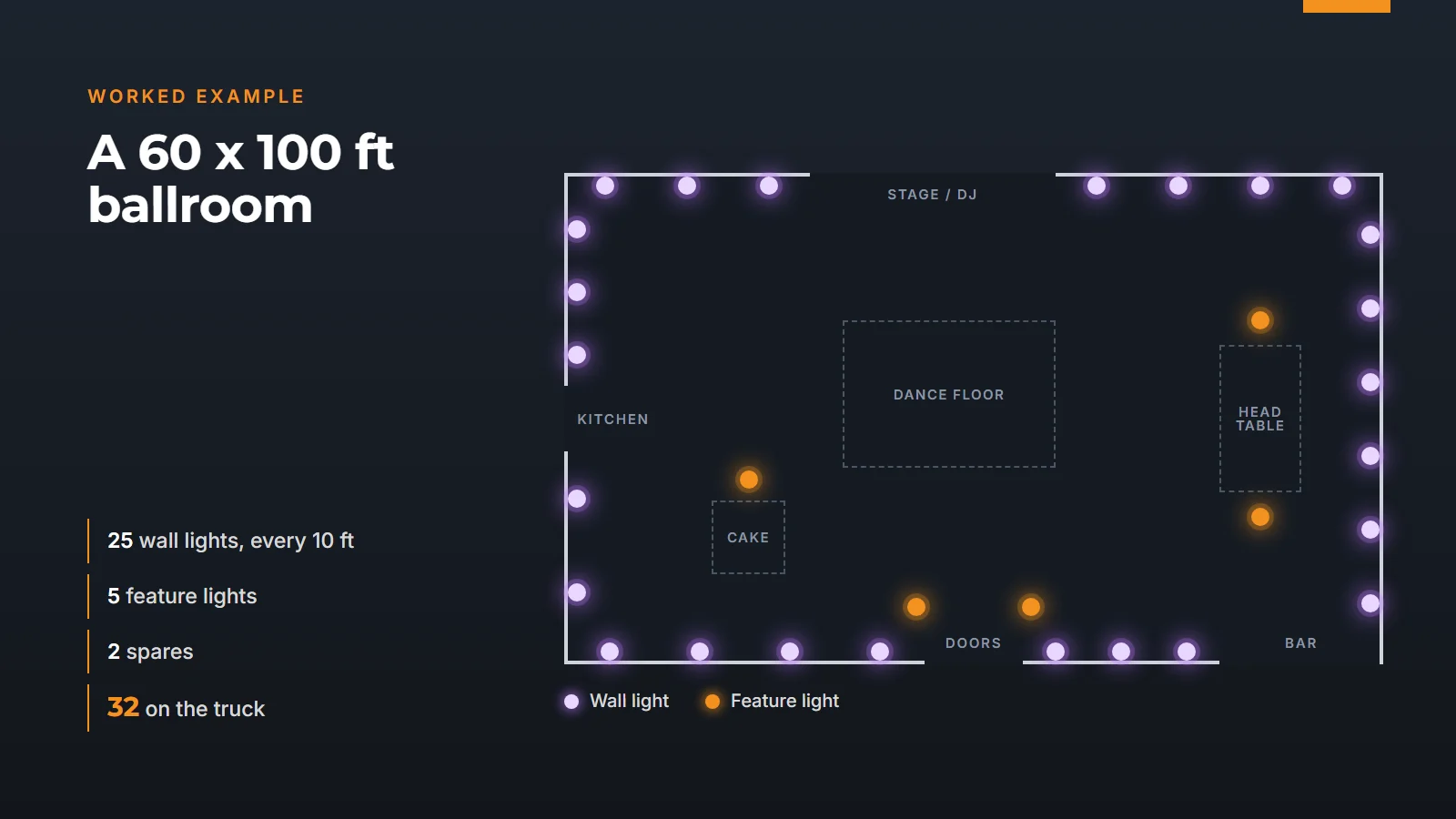
Here is the full count for a typical hotel ballroom with about 300 guests.
Top wall, 100 ft: the stage and DJ take 30 ft in the middle. 70 ft left, so 7 uplights.
Bottom wall, 100 ft: 12 ft of main doors and a 20 ft bar. 68 ft left, so 7 uplights.
Left wall, 60 ft: an 8 ft kitchen door. 52 ft left, so 5 uplights.
Right wall, 60 ft: no openings, so 6 uplights.
Features: 2 behind the head table, 1 on the cake, 2 at the entrance. 5 uplights.
Spares: 2.
Total: 25 wall lights + 5 feature lights + 2 spares = 32 fixtures. The guest rule would have said 38 to 50.
What should get its own uplight?
Feature lights are where guests look and where the photographer points the camera. Count them separately from the wall:
Head table or sweetheart table: 2 behind it, one on each side, so the couple isn't lit from one side only.
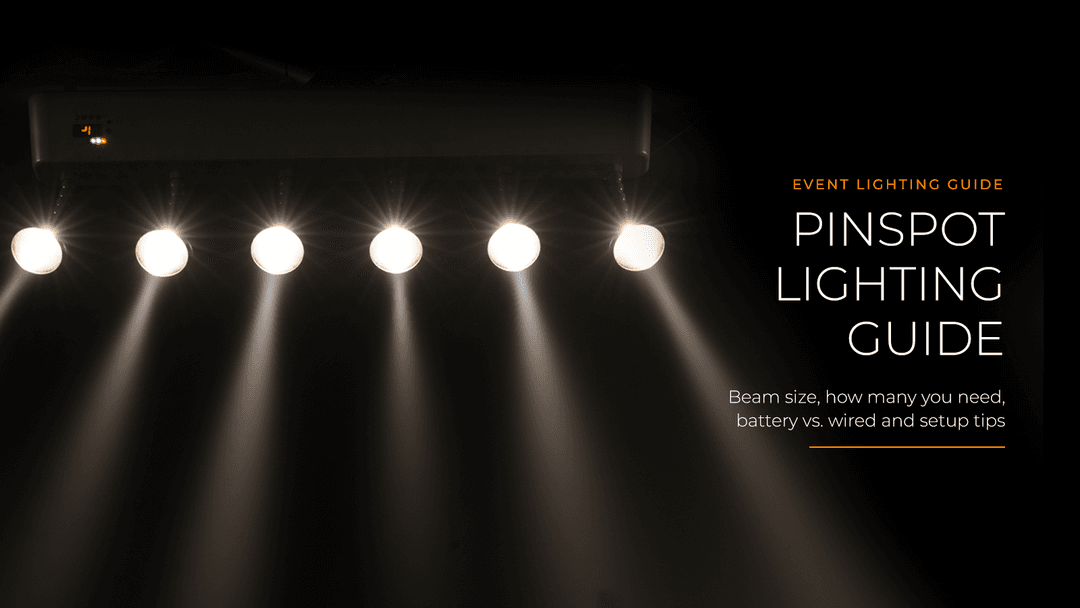
Cake table: 1, aimed at the cake or the wall behind it. A pin spot from above is another good option. See our pin spot lighting guide.
Entrance: 1 or 2, so the room looks finished from the first step in.
Columns: 1 per column, at the base.
Bar front, photo booth backdrop, ceremony arch: 1 or 2 each if they are part of the plan.
What should you leave dark?
Fire exits and doors. Never block an exit with a fixture or a cable.
Windows during daylight. Uplights won't show against daylight. After dark, with drapes closed, the drapes are worth lighting.
Mirrors. A mirror throws a bright spot back into guests' eyes.
The stage or band wall if the band brings its own lights.
Service paths and kitchen doors. Staff move fast here. A fixture on the floor is a trip hazard.
What if you have fewer uplights than the room needs?
Light the walls guests face, not every wall. Most of the night, people look toward the head table and the dance floor. Put your fixtures on those walls at full spacing and leave the back of the room dark or soft. Eight to 12 uplights placed well look better than 12 spread thin around the whole room with big dark gaps.
Battery or wired uplights?
For weddings that move from venue to venue, battery-powered uplights save the most time. There are no power cables across the floor, no hunting for outlets behind tables and nothing for guests to trip on. Before you choose, check the runtime against the whole day. Lights often go on for photos in the afternoon and stay on until the last song, which can be 8 hours or more.
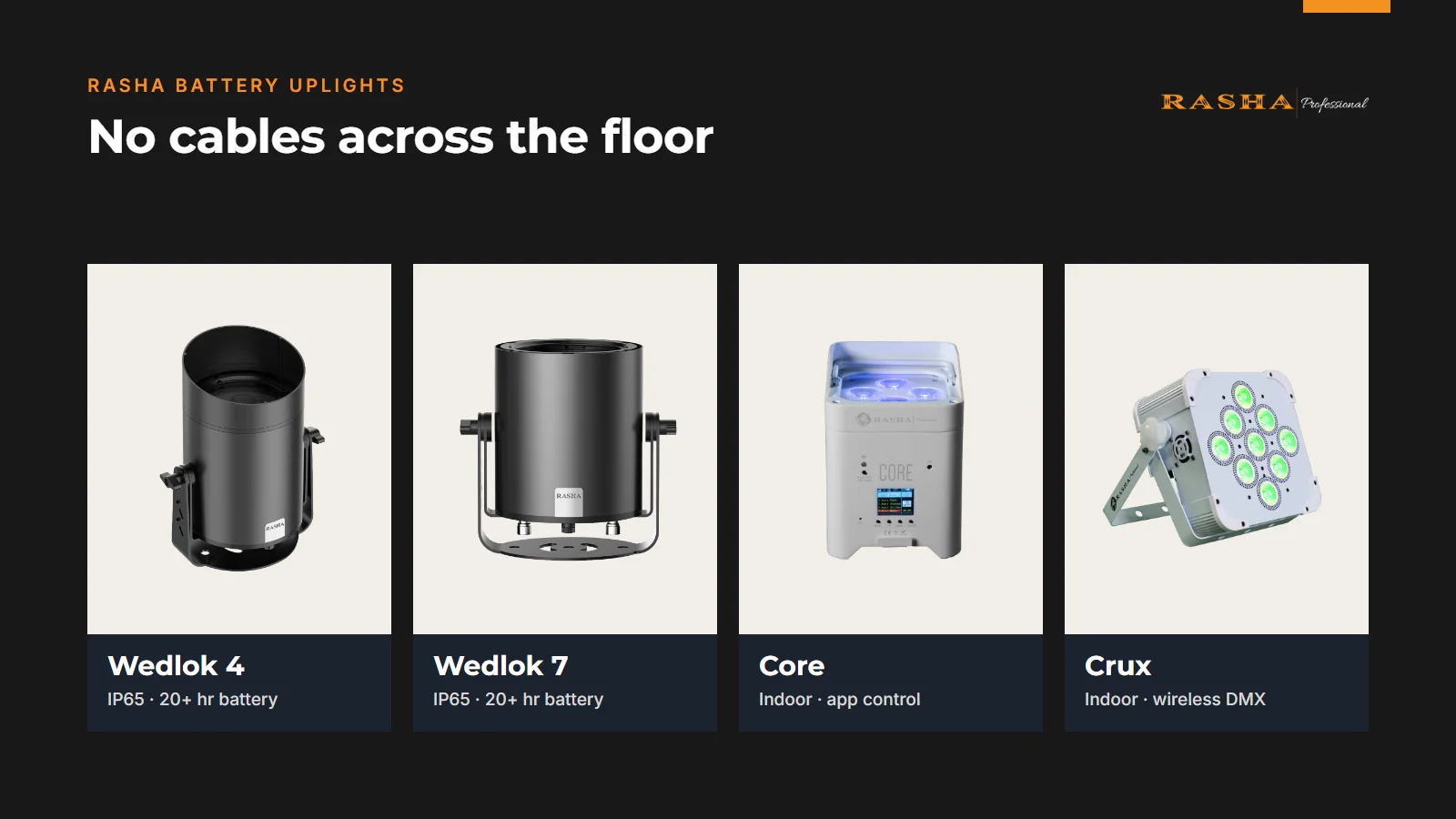
Rasha's battery uplights all work without a power cable during the event:
Wedlok 4: IP65, a six-color RGBACL engine for cleaner whites and pastels, a 20+ hour battery, wireless DMX and an IR remote. Its 25° beam gives clean columns on walls and pillars.
Wedlok 7: the same IP65 housing, RGBACL color and 20+ hour battery, with a smoother wash for walls, fabric and drape.
Core IP: IP65 with RGBWA+UV color, up to 20 hours on a single color, CRMX wireless control and silent, fanless operation. Good for tents, patios and garden receptions.
Core: an indoor uplight with RGBAW+UV color, up to 10 hours of battery and control from a phone app.
Crux: an indoor uplight with RGBAW+UV color, a 25° beam, 2.4 GHz wireless DMX and 32 built-in color presets. Set one unit as master and the rest follow it.
See the full range on the battery-powered uplights page. To change every fixture at once, for example from warm white at dinner to color for dancing, add a wireless DMX transmitter.
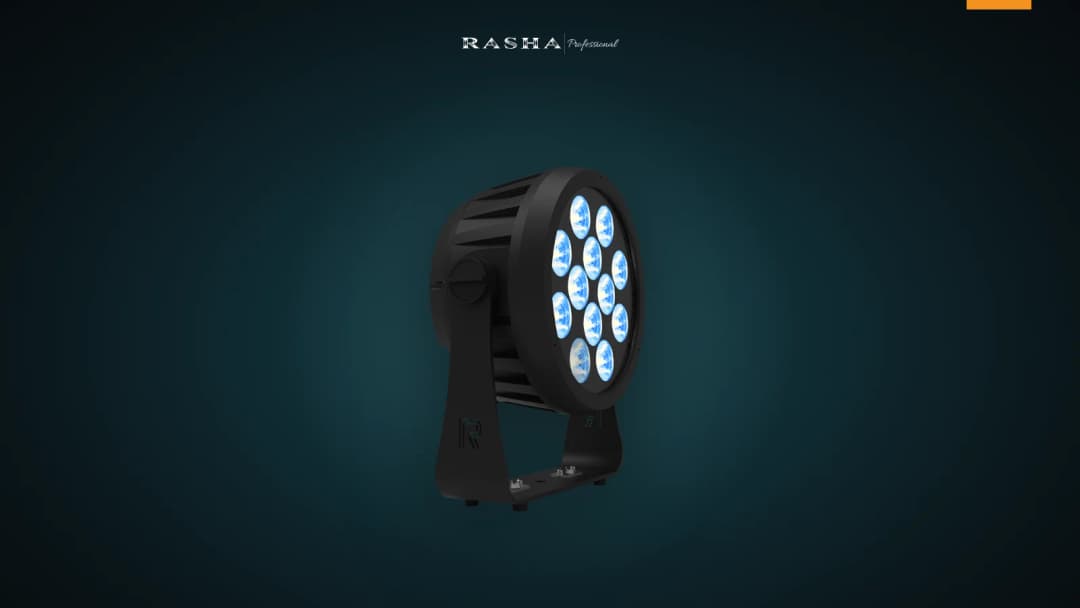
For venues that light the same room every weekend, a wired fixture can make more sense. The Rodie X12 is an IP65 wash light with a built-in timer that turns the lights on before guests arrive, with no charging between events. At 120 V it draws 1.0 A at most, so 13 fixtures can link on one power chain.
Wedding uplighting checklist
Get the floor plan, or measure every wall yourself.
Mark doors, exits, the stage, the bar, the kitchen and windows.
Agree on the look with the couple: bold, classic or subtle.
Divide the usable wall by that spacing.
Add feature lights for the head table, cake, entrance and columns.
Add 2 spares.
Check battery runtime against the full day, from first look to last dance.
Charge everything the night before and label each fixture by wall.
Place fixtures 12 to 18 inches from the wall and tilt them up.
Walk the room with a phone camera before doors open.
Plan your next room with Rasha
Send us the floor plan and the guest count. We'll help you work out the count, the spacing and the right fixture for the room.
Book a demo with the Rasha team
Find a Rasha reseller near you
Contact Rasha, or call +1 (951) 654-3585
Related reading
Frequently asked questions
Quick answers about how many uplights a wedding reception needs.
Plan one uplight for every 8 to 10 feet of usable wall, then add 3 to 6 for features like the head table, cake and entrance, plus 2 spares. Most reception halls of 100 to 400 guests need about 18 to 40 uplights.
A room for about 150 guests is often around 40 by 60 feet, with about 160 feet of usable wall. That is 16 uplights at 10 feet apart or 20 at 8 feet apart, plus feature lights and 2 spares, so about 21 to 28 in total.
Place uplights 6 to 8 feet apart for a solid wall of color, 8 to 10 feet apart for the classic look, or 12 to 15 feet apart for separate accents. On low walls, space them closer, since the beam has less height to spread.
By wall length. Guest count grows with floor area, while wall length grows more slowly, so a rule like one uplight per 8 guests gives too many lights in a large ballroom and too few in a long, narrow room.
Set uplights about 12 to 18 inches from the wall and tilt them up, so the light runs up the surface in a column. Closer gives a tighter, brighter column; farther gives a wider, softer one.
No. If you have fewer fixtures, light the walls guests face most, usually behind the head table and around the dance floor, at full spacing. A few walls lit well look better than every wall lit with big gaps.
Plan for 8 hours or more, since lights often go on for afternoon photos and stay on until the last dance. The Rasha Wedlok 4 and Wedlok 7 have a 20+ hour battery, and the Core IP runs up to 20 hours on a single color.

Tyler Hayes
With over 15 years in the entertainment lighting scene, Tyler Hayes has helped shape unforgettable live experiences across stages, clubs, and festivals. He writes about how lighting transforms moments into lasting memories. His passion lies in inspiring others to see light not just as illumination, but as the heartbeat of every great event.
Related posts
Posted on 11/17/2026
Outdoor Event Lighting in Cold Weather: What Cold Does to LED Fixtures
Quick answer: LED fixtures handle cold well, as long as you stay inside the fixture's rated operating te
Posted on 10/21/2026
Pin Spot Lighting Guide: What It Is, How Many You Need and How to Choose
Quick answer: Pin spot lighting uses small fixtures with a very narrow beam, usually 3° to 15°, to light
Posted on 10/19/2026
What to Look for in an LED Wash Light: 10 Features That Matter
Quick answer: When you buy an LED wash light, check ten things: the color engine, color rendering (CRI),
Posted on 07/23/2026
Battery Powered Pinspot Bar: What Rental Companies Need to Know Before Adding One to Inventory
If you run a rental company, you already know most lighting fixtures are built for a showroom, not a truck. They look great on a demo table and fal
Posted on 07/15/2026
Church Lighting Upgrade Guide: How to Plan a Modern Worship Lighting System
I have stood on more church platforms at 11 pm on a Saturday than I can count, aiming a fixture at a pulpit while someone holds a ladder. Church li
Posted on 07/01/2026
How Do I Choose the Right Professional Stage Lighting Manufacturer for My Production Company?
A practical buying guide for production companies, rental houses, and lighting designers evaluating manufacturer partnerships — not just product sp
Posted on 05/14/2026
Why U.S. Production Companies Are Rethinking Their Stage Lighting Strategy in 2026
A Complete Guide to Choosing the Right Professional Stage Lighting Partner — and Why It Starts with Rasha Professional
What Is Profe
Posted on 04/23/2026
LED Video Wall & Smoke Fogging Machine Guide
An LED video wall and smoke fogging machine are essential components of modern stage lighting and event production. LED video wall panels provide h

Let us help you elevate your business through innovative lighting and expert solutions.


Copyright © 2026 Rasha Professional. All Rights Reserved